Moving to Glenvar Heights: What New Residents Should Know
The questions I get from clients in their first month here are rarely about the house. They are about who picks up the trash, which office issues the pool permit, why the tax bill looks different from the one their friends in Coral Gables pay, and whether the peacocks are a joke. I have lived in Glenvar Heights for more than ten years and grew up five minutes away, so this is the practical version of the answers, written for someone who has just closed or is about to.
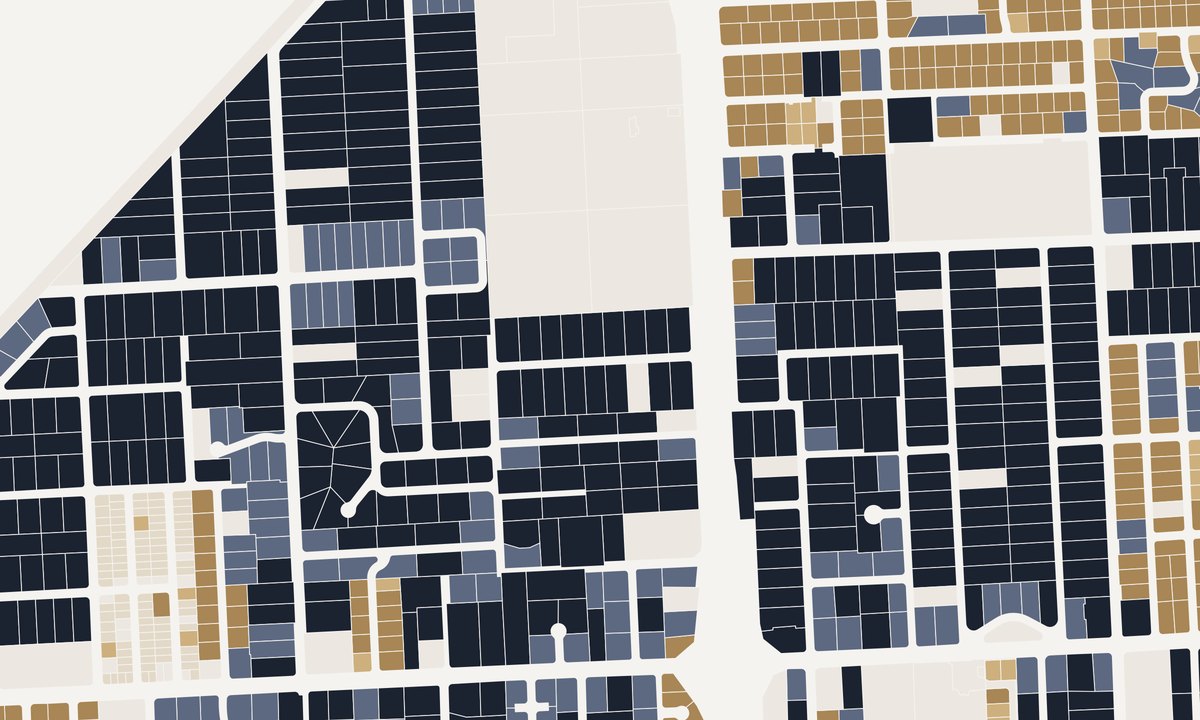
The short version: you are moving into 4.08 square miles of unincorporated Miami-Dade County, across zip codes 33155 and 33143. Glenvar Heights is bounded by Bird Road on the north, roughly SW 62nd to SW 67th Avenue along its stepped eastern edge, and roughly SW 82nd Street on the south. SW 85th Avenue forms its western edge, with the Don Shula Expressway along part of its northwestern boundary. That one word, unincorporated, explains most of what follows.
You Live in the County, Not a City
Glenvar Heights has no city hall, no city commission and no municipal police force. Miami-Dade County provides law enforcement through the Miami-Dade Sheriff's Office, handles permitting, and collects the taxes. That arrangement dates to 1937, when residents of what was then the northern section of South Miami sued their way out of the city and reverted to unincorporated status. The irregular boundary lines on today's maps and the absence of a city tax both come from that decision.
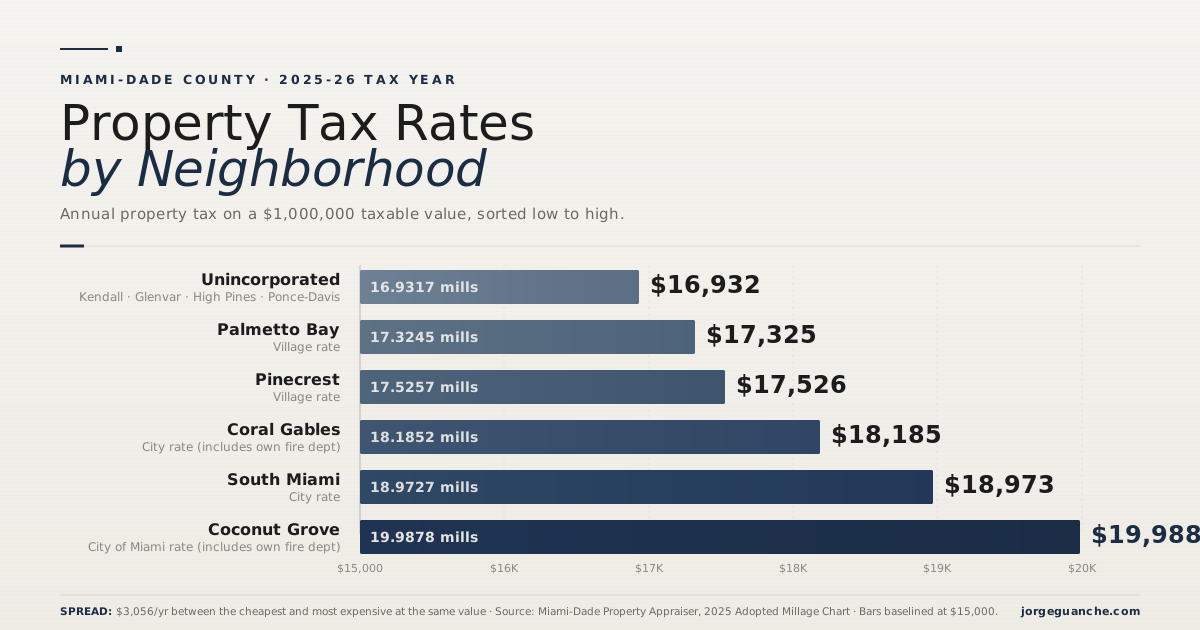
On the tax bill, the difference is a line item you do not pay. Unincorporated Miami-Dade carries a combined 2026-27 millage of 16.8983 mills. Coral Gables is at 18.1518, Pinecrest at 17.4923 and South Miami at 18.9393. On $1,000,000 of taxable value that is $16,898 a year here against $18,152 in the Gables and $18,939 in South Miami. The full millage breakdown covers all eight neighborhoods I work, and the property tax calculator runs the number for your purchase price.
Two dates matter in year one, and they are different things. Eligibility is set on January 1: you need legal or equitable title and the house as your permanent residence on that date. The application then goes to the Miami-Dade Property Appraiser by March 1 of that tax year. If you are carrying a Save Our Homes benefit from a previous Florida home, the portability form goes in at the same time. My homestead and portability guide walks through both. Then watch for the TRIM notice in August, which opens the 25-day window to petition the assessment. A late petition needs a good cause finding, so treat the date as firm; the TRIM appeal guide explains when that is worth doing and when it is not.
Checking HOA Rules Before You Buy
Glenvar Heights is unincorporated, so county requirements apply. That does not establish whether an individual property has an HOA, recorded covenants or other private restrictions. Most of the neighborhood has no mandatory homeowners association, and recorded covenants do exist on some platted blocks, so review the title documents, recorded restrictions, zoning and permit history for your property before you plan a fence, a paint color or an addition.
Where this shows up most is renovation. Pools, guest houses, kitchen guts and additions all run through the Miami-Dade County permitting office rather than a municipal board of architects. That changes which office you deal with. It does not establish how long any particular permit will take, so build the review into your schedule and pull the permit history on the property before you plan the work. If the house you bought is an original 1950s or 1960s ranch, my renovation cost breakdown has the 2026 per-square-foot numbers, and the renovation feasibility calculator will pull the lot, zoning and living area for your address from the county record.
Your Address Decides More Than Your Neighborhood Does
Glenvar Heights straddles two zip codes: 33155 in the north, roughly down to Miller Drive, and 33143 in the rest. Neither zip stops at the neighborhood line, so a zip-level statistic, whether it is a home value or an insurance quote or a school assignment, is describing a much larger area than the block you live on. Three things in particular are set by the exact address rather than the neighborhood.
School zoning comes first. For most Glenvar Heights addresses the zoned public schools are Ludlam Elementary, South Miami Middle and South Miami Senior High, but boundaries shift, magnet programs accept out-of-zone applicants, and the private options inside and around the neighborhood are part of most families' decision. I keep a separate, current write-up on schools near Glenvar Heights; check your specific address with Miami-Dade County Public Schools before you count on any of it.
Insurance comes second. Large portions of Glenvar Heights sit in FEMA Zone X, outside the 100-year floodplain, so there is no federal requirement to carry flood insurance, though a lender can still ask for it, and Citizens requires it on personal residential policies once the dwelling limit reaches $400,000 in 2026 and on all of them from 2027, with condo unit-owner policies, tenant contents policies and policies without wind coverage exempt. Many owners carry it anyway. Wind coverage is priced off the wind mitigation form, and the credits depend on the roof, the openings and the documentation behind them. If you are still inside your inspection period, order the 4-point and wind mitigation inspections in week one; the 2026 insurance guide covers what fails and what earns a credit.
Comparable sales come third. The two zip codes price apart, but a zip-level statistic covers far more ground than the neighborhood, so it does not establish who is buying on your block or how they are paying. The full picture is in the lot sizes and subdivisions article. For now, know that the comps that apply to your house follow the block and the condition, and neither one follows a postal boundary.
Getting Around
Highway access is the practical advantage this neighborhood has over Pinecrest and Coral Gables. The Palmetto Expressway passes through the center of the CDP, the Snapper Creek Expressway crosses the southern portion, and the Don Shula Expressway runs along part of the northwestern boundary. US-1 and Bird Road frame it on the east and north. Three expressway options plus two arterials means you can change route when traffic changes.
Outside rush hour, the airport is 10 to 15 minutes via the Palmetto, Downtown and Brickell 15 to 20, the University of Miami about 7, Dadeland Mall 4 to 5, and Miami Beach about 25 via US-1 and the Julia Tuttle. Fort Lauderdale runs 40 to 50 minutes and Key Largo 45 to 60 via the Turnpike. Treat those as the floor. Between 7 and 9 in the morning and 5 and 7 in the evening, US-1 and the Palmetto can double them. On a typical morning I reach the airport in 12 minutes, Brickell in 18 and UM in under 10.
Transit exists but the neighborhood is car-dependent. The Dadeland North and Dadeland South Metrorail stations are 2 to 3 miles away and connect to Government Center, Brickell, Coconut Grove and South Miami; Dadeland North sits on the Glenvar Heights and Kendall border. Metrobuses run along Sunset Drive daily. Most households here have two cars, per DataUSA, and daily errands assume one.
Parks, Groceries and Dinner
There is more parkland within a short drive than most new residents expect. Tropical Park, 283 acres at Bird Road and the Palmetto, is about two miles from the center of the neighborhood: paved loops for running and cycling, softball and soccer fields, a boxing center and a dog park. A.D. Barnes Park on Bird Road is 65 acres with a fishing lake, a heated pool, a 15-acre pine rockland and some of the best birding in the county, per Miami-Dade Parks. Dante Fascell Park on Red Road has six clay tennis courts, and Brewer Park, a City of South Miami park a few minutes away, has become the pickleball hub; the courts fill by 7 on Saturday mornings, and if you want to meet your neighbors, that is where they are. The Ludlam Trail along the old FEC rail corridor is in design. The county awarded a design contract in July 2026 for the 5.6-mile corridor from SW 80th Street to about NW 7th Street. Design is not construction, and no opening date has been set.
Retail sits at the edges rather than inside. Dadeland Mall is about four minutes away, Dadeland Station about six for Target and Best Buy, and Suniland in Pinecrest about eight for the post office, CVS and a row of restaurants. The Whole Foods people mean when they say Dadeland is its own store at 7930 SW 104th Street, not part of the Station. For dinner, Bird Road on the northern border is the weeknight corridor, dense with Cuban cafes and independent restaurants; Jamaica Kitchen at Sunset and Galloway is the neighborhood institution; and the South Miami city center, six to ten minutes east, has the walkable restaurant row this neighborhood does not.
The House You Bought
Most of the housing stock went up between the 1950s and 1970s: single-story concrete block ranches, terrazzo or tile floors, large screened patios, mature specimen trees front and back, and driveways sized for a boat. For an older house, assess the actual roof, structural condition, permits and improvements rather than treating the construction era as a guarantee of quality. Those period features are details to inspect in the individual home; they do not establish hurricane performance or what it will cost to bring the house to the condition you want. The median lot is 16,438 square feet for closed single-family sales from April 2025 through March 2026, and most fall between 10,000 square feet and an acre.
If your house is original, the permit history is the first thing to pull. Open or expired permits, the age of the roof, the electrical panel and the plumbing supply lines are what an insurer and a future buyer will both ask about, and the county record is the one place they are all written down.
What It Is Actually Like
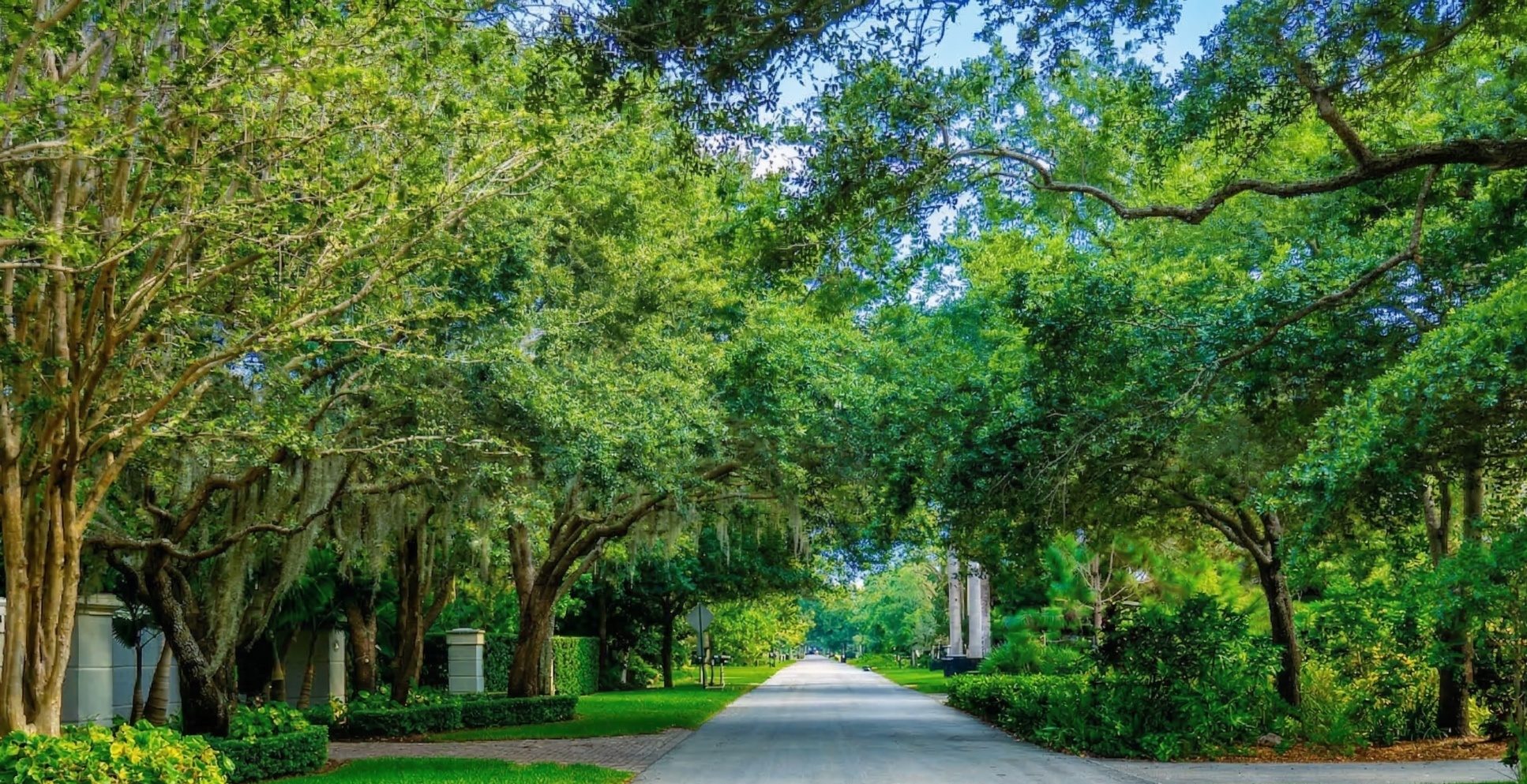
Peacocks do roam the streets, and neighbors do know each other by name. Mature oaks and banyans shade most of the interior streets, and the neighborhood sits far enough back from the arterials to be quiet on a weekday morning. There are no entry monuments, no manicured medians and no branding. Some blocks feel almost rural, and you can stand in front of certain houses and forget you are ten miles from downtown.
The population is multigenerational. Original owners who bought in the 1960s live next to families who closed last year, and that mix is what gives the place a stability planned communities do not have. The Census ACS 2020-2024 estimate counts 9,241 households here across all housing types, which is a dated count rather than a description of who is buying now. It takes a year or two to read the block-by-block texture. Give it that.
The First-Month Checklist
Pull the permit history on the house from the county. Confirm the school assignment for your exact address with Miami-Dade County Public Schools. Get three insurance quotes on the actual address if you have not already, and put the wind mitigation report somewhere you can find it. Calendar March 1 for homestead and portability, and August for the TRIM notice. Read the title commitment for any recorded covenants on your plat before you plan a fence. Then go to Brewer Park at 7 on a Saturday.
If a specific question about your block comes up, the fastest answer is a call. I have walked every one of these streets, and the neighborhood-level guide to living in Glenvar Heights has the market numbers behind everything above.
Sources
Miami-Dade Property Appraiser, homestead exemption filing; 2026-27 millage from the September 2026 final budget hearings of Miami-Dade County, the School Board and each city, verified October 2026
Miami-Dade County Public Schools, School boundary and assignment lookup
Miami-Dade County Parks, Tropical Park
Miami-Dade County Parks, A.D. Barnes Park
City of South Miami, Dante Fascell Park
U.S. Census Bureau, Glenvar Heights CDP QuickFacts, households and 2020 land area
City of South Miami, Brewer Park
Miami-Dade County, Ludlam Trail design contract award, July 22, 2026
Miami-Dade County, Metrorail schedules, fares and stations
Miami-Dade Property Appraiser, Homestead exemption requirements
DataUSA, Glenvar Heights, FL profile (vehicles per household)
SE Florida MLS via Compass, Closed single-family sales classified by mapped location, Q2 2026; median lot size from closed single-family sales, Apr 2025 - Mar 2026