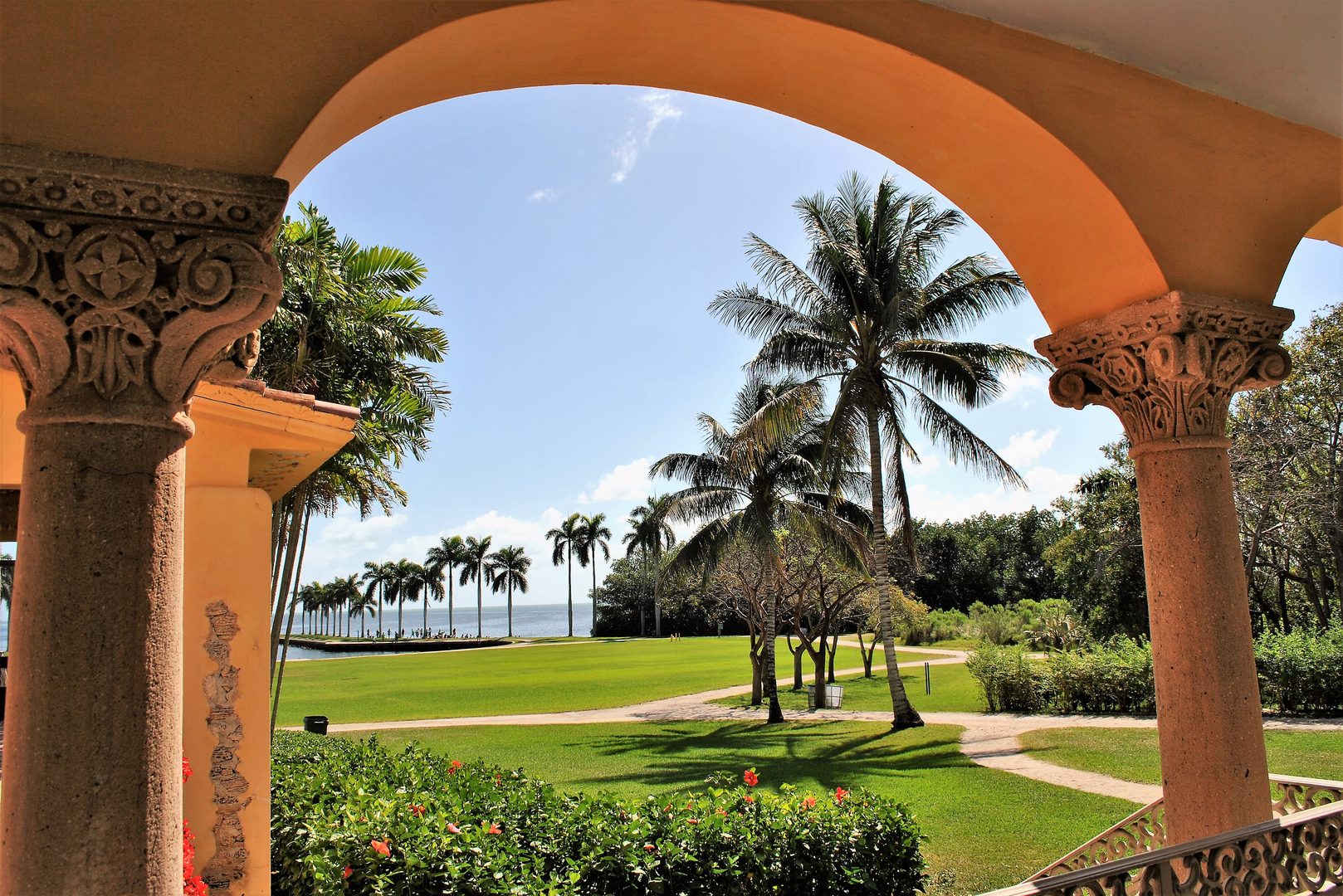
Photo: Elisa Rolle, CC BY-SA 4.0, cropped

Neighborhood Boundaries
Palmetto Bay
Interactive map of Palmetto Bay and six surrounding Miami-Dade neighborhoods. Use the links below the map to open any neighborhood guide.
Neighborhood Overview
Living in Palmetto Bay
Palmetto Bay calls itself the Village of Parks. It covers 8.29 square miles of southern Miami-Dade, with village government and direct frontage on Biscayne Bay. Population was 24,886 in the July 1, 2025 Census estimate, and the residential pattern here is well-established suburban character that has held its form as the surrounding region has urbanized.
The waterfront is part of the village's history as well as its present. The Charles Deering Estate, a National Register Historic Site on the bay, is the cultural landmark of the area. Thalatta Estate Park adds green space and community event grounds. Through the rest of the village, you get tree-lined streets, generous lots, and well-kept homes.
The schools are a major draw. Howard Drive Elementary (9/10), Coral Reef Elementary (9/10), Dr. Henry E. Perrine Academy of the Arts (9/10) and Southwood Middle (9/10) carry high GreatSchools ratings, checked September 18, 2026, and Miami Palmetto Senior High graded A from the state for 2025-26. Private options include Westminster Christian School and Palmer Trinity School. School assignment depends on the property address, and magnet programs have separate application requirements. Median household income was $142,447 in the ACS 2020-2024 estimate, in 2024 dollars, which describes households across all housing types rather than current homebuyers.
Palmetto Bay trades at a lower price point than Pinecrest and Coral Gables while sharing several of the same draws, including large lots, parks and highly rated elementary schools. After two decades in Southwest Miami-Dade, that's the comparison work I run for buyers weighing Palmetto Bay against those two neighbors.
Palmetto Bay Real Estate Market Snapshot
Updated Q3 2026
Closed sales (Q3 2026 vs Q3 2025)
| Metric | Q3 2026 | YoY |
|---|---|---|
| Median sold price | $1,200,000 | +9.4% |
| Median $/SF | $502 | +2.9% |
| Median days to contract | 41 days | -10 days |
| Closed sales | 87 | +11.5% |
Active inventory (as of October 4, 2026)
| Metric | Value |
|---|---|
| Active single-family listings | 80 |
| Median list price | $1,597,000 |
| List price range | $669,900 to $6,500,000 |
| Under contract | 35 |
Single-family homes reassigned to Palmetto Bay by mapped location. Closed figures Q3 2026 vs Q3 2025. Active inventory as of October 4, 2026, excluding Coming Soon and Private Exclusive listings; under contract includes pending, active-with-contract and active-under-contract listings. Source: SE Florida MLS, polygon-classified. Full Q3 2026 market report for all 8 neighborhoods.
Market Intelligence
Market Analysis: Single-Family Homes
Every sale on this page is counted by where the parcel sits on the map, which matters along the village's borders with Cutler Bay, Pinecrest and Perrine, where listings are often mislabeled (how the numbers are built).
What You Will Actually Pay
Over the past twelve months, 319 single-family homes sold in Palmetto Bay at a $1,165,000 median, and the middle half closed between about $900,000 and $1.5 million. The price bands below come from those sales.
Below $900,000, about a quarter of sales, the homes were mostly older and smaller, with a median of about 1,700 square feet and a median build year of 1971. Sixty-three of those 77 sales were on the western side of the village, toward US-1.
The core of the market runs from $900,000 to $1.5 million and held about half of all sales. The median home in that band had about 2,300 square feet on a lot of about 15,700 square feet, close to the village-wide lot median.
From $1.5 million to $3 million, another quarter of sales, the median home grows to about 3,200 square feet on a somewhat larger lot. Above $3 million there were only 11 sales, eight of them built in 2015 or later, and nine of the 11 were on the eastern side, toward the bay.
Flood zone is set by the parcel in every band, so check the specific address before you compare two houses on price.
What I Tell My Clients
Supply here was the tightest of the eight areas I cover on October 4, at 2.8 months, and anything under four months favors sellers. Buyers should line up a current pre-approval and see new listings the week they come on, especially in the $900,000 to $1.5 million band, which carries about half the sales. Sellers still need to price from the closed sales nearest the house in size, lot, condition and flood exposure. In my experience, the Palmetto Bay listings that sit are the ones priced ahead of those comps. Near the bay, I pull the parcel's flood information and confirm any dock or water-access rights before we set a price or write an offer.
Competitive Analysis
How Palmetto Bay Compares
Palmetto Bay and Kendall carry the lowest prices of the eight areas I cover, close to each other on median price and on price per square foot, and both well below Pinecrest, the neighbor to the north. Days to contract were similar across most of the table this quarter, so supply is the bigger difference, and Palmetto Bay's is the tighter. Kendall is the closest comparable on price and lot size, which is why I wrote a separate Palmetto Bay vs. Kendall comparison.
Median price per square foot, single-family homes, each sale classified by mapped location. Basemap © OpenStreetMap contributors. Full Q3 2026 report.
| Neighborhood | Median sold | YoY | $/SF | Days to contract | Closed |
|---|---|---|---|---|---|
| Pinecrest | $2,900,000 | +14.4% | $832 | 43 | 63 |
| Coconut Grove | $2,800,000 | +21.7% | $1,245 | 45 | 57 |
| Coral Gables | $2,102,500 | +12.1% | $923 | 40 | 96 |
| Glenvar Heights | $1,810,000 | +4.6% | $823 | 40 | 17 |
| South Miami | $1,391,500 | +10.9% | $738 | 43 | 22 |
| Kendall | $1,200,000 | +13.5% | $496 | 41.5 | 93 |
| Palmetto Bay | $1,200,000 | +9.4% | $502 | 41 | 87 |
| High Pines + Ponce-Davis | n/m | n/m | n/m | n/m | 3 |
Source: MLS closed single-family sales, reassigned to true neighborhood boundaries by parcel location. Q3 2026 vs Q3 2025. High Pines + Ponce-Davis had 3 sales, too few to measure, so it is shown without figures. Glenvar Heights (17) and South Miami (22) are small samples. n/m = not meaningful.
Why Palmetto Bay
The Value Proposition
The closest comparisons run west and north. Kendall sits on comparable 15,000 SF lots, and Pinecrest trades at a much higher price point on half-acre-plus parcels further north. What Palmetto Bay adds that neither neighbor offers is Biscayne Bay frontage along the Old Cutler Road corridor. Frontage is a property-by-property question, so confirm any dock, marina or slip rights in the documents and read the address's flood information and insurance costs separately. Inland, Howard Drive Elementary (9/10) covers the village interior and Coral Reef Elementary (9/10) anchors the south end.
The village runs its own government, and its code caps commercial density and prioritizes residential character outside the designated downtown redevelopment area. The combined property tax rate is 17.3393 mills, second lowest of the areas I cover (full per-neighborhood breakdown).
My own Palmetto Bay work includes 6731 SW 138th St, a four-bedroom home on a 0.52-acre lot that sold for $1.88M.
Shortlisting homes here and in Pinecrest or Kendall? Send me the addresses and I will compare the lots, school assignments, flood information and recent sales side by side. Discuss this property.
Know the Pockets
Subdivisions & Micro-Neighborhoods
Palmetto Bay reads as one continuous suburb to a passing driver, but it is really a set of distinct pockets, and the differences drive price more than the village-wide median suggests. Broadly, the village splits along Old Cutler Road, which runs north to south near the bay side and separates the waterfront and bay-adjacent parcels to the east from the larger interior to the west.
The waterfront and bay-adjacent corridor along Old Cutler Road is the top of the market. Several small gated communities sit here. Old Cutler Cove is a smaller pocket of some 94 custom homes on larger lots just south of SW 144th Street, on the inland side of Old Cutler Road. Paradise Point, built in the early 2000s at the southern end of the Gables Waterway, is a gated, guarded community of newer waterfront homes. These are the parcels behind the top of the price range, the ones that clear well above $2,000,000. If a buyer's priority is a boat and open-water access, this is where the search concentrates, and that supply is finite.
The interior, west of Old Cutler Road, is the residential heart of Palmetto Bay and the source of most of the $1,000,000 to $1,600,000 closings. Lot sizes across the interior commonly run from 10,000 square feet to well over 40,000 on the larger estate parcels, with the village median at 15,670 square feet. Much of the interior is unincorporated-style large-lot suburban platting from the postwar decades, without HOA governance, which many buyers prefer for the freedom it gives on the property. Some of the newer or gated pockets do carry association rules; that is worth confirming lot by lot rather than assuming, because it varies within a few blocks.
The south end, closer to the Cutler Bay line and the Perrine area, carries a wider price range and more of the sub-$1,000,000 inventory. This is where value-oriented buyers find the entry points into a Palmetto Bay address, often on smaller lots or in homes that need work. The tradeoff is real and worth naming: some of the south-end and bay-adjacent parcels carry different flood-zone designations than the higher interior, which affects insurance cost and, increasingly, financing. I walk every buyer through the specific flood zone and elevation for a given address before we get attached to it, because in this market the insurance line can move the true monthly cost by a meaningful amount. Insurance rates in Miami-Dade are finally coming down in 2026, and I cover what the decreases mean, along with how to lower your own premium, in a separate piece.
Education
Schools & Education
Schools are the primary demand driver in Palmetto Bay, and unlike a lot of neighborhood copy, the ratings here hold up when you check them. The figures below are GreatSchools ratings, checked September 18, 2026.
On the public side, the village is served by three strongly rated elementary schools. Howard Drive Elementary (PK-5) carries a 9/10 GreatSchools rating. Dr. Henry E. Perrine Academy of the Arts (K-5), a magnet with a gifted-and-talented program, also rates 9/10. Coral Reef Elementary (PK-5) rates 9/10. All three run above the Florida average for their grade levels on state proficiency measures.
For middle school, Southwood Middle (grades 6-8) rates 9/10 and is worth understanding beyond the number. It runs a long-established visual and performing arts magnet program, and for a student interested in the arts that program is a reason to choose the school on its own.
At the high school level, most of the village feeds toward Miami Palmetto Senior High (grades 9-12), a large magnet high school with AP offerings, a gifted program, and a broad athletics slate. The state graded it A for 2025-26, and the school is well known regionally. If your plan hinges on the high school specifically, tour it and look at the program your student would actually use, because a school this large serves a very wide range of students.
On the private and independent side, Palmetto Bay and its immediate surroundings have real private options. Westminster Christian School and Palmer Trinity School are the two most commonly cited, both long-established college-preparatory schools drawing from across South Miami-Dade. Assignment boundaries and magnet eligibility change, so I always tell buyers to confirm the current zoned schools for a specific address with Miami-Dade County Public Schools directly before making a purchase decision on school grounds. A house two blocks away can zone differently than you assume.
Daily Life
Lifestyle & Community
Palmetto Bay's day-to-day character is set by two things: the bay on its eastern edge and an unusual density of parks for a village its size. The park system is the main amenity.
The anchor is the Charles Deering Estate, a bayfront historic site of more than 400 acres that served as industrialist Charles Deering's winter home. Beyond the historic structures, the grounds hold about 111 acres of tropical hardwood hammock, plus access to Biscayne Bay, canoe and kayak launches, and a regular calendar of cultural programming. It is both a nature preserve and a cultural venue, and it is the single feature most responsible for the village's identity.
Coral Reef Park is the recreational center of gravity, more than 50 acres of ball fields, tennis and pickleball courts, a large playground, an exercise trail, and preserve areas. A new recreation center and additional pickleball courts opened at the park in March 2026, expanding its programming. Thalatta Estate Park adds nearly four acres of green space with open bay views and a restored historic home used for community events and weddings; the name comes from a Greek word for the sea, and the setting earns it. Between the three, plus the smaller neighborhood parks, most of the village is a short drive from a large park.
On the practical side of daily life, the village keeps its commercial footprint deliberately small. The US-1 corridor supplies the everyday errands, grocery, pharmacy, casual dining, and services, and the broader retail of Pinecrest and the Dadeland area sits a short drive north. Much of Palmetto Bay has an established suburban residential pattern with no walkable downtown or nightlife district today. Its designated downtown district has a different planning direction: the village's 2020 code promotes walkable, mixed-use development. Treat that policy separately from what has already been built, and check current projects near the home you are considering. If a client's priority is walk-out-the-door dining and urban energy, I steer them toward South Miami or Coconut Grove and tell them so plainly. Palmetto Bay's appeal is quiet, green and residential, and it does not pretend otherwise.
Getting Around
Transportation & Access
Palmetto Bay is a car-first suburb. There is no Metrorail station in the village. Miami-Dade's rail line ends to the north at Dadeland South, and Palmetto Bay residents who want rail typically drive to the Dadeland park-and-ride stations and connect from there, though the right station and route depend on where in the village the property sits. The US-1 corridor along the village's western edge carries the South Dade TransitWay, where Metro Express bus service runs up the South Dixie Highway spine to Dadeland South, which is a real option for a US-1-aligned commute but is not a substitute for door-to-door rail. Miami-Dade announced completion of the 87th Avenue bridge in July 2026, adding a connection across the C-100 Canal. If that route matters to your commute, test it from the actual property at your usual travel time; the announcement does not establish a specific time saving for every household. Plan on owning a car here. Dadeland South access update, checked September 19, 2026: station construction affects bus access, traffic flow and pedestrian routes. The station is open. Check the county's current project advisory before planning your connection.
For drivers, the two arteries are US-1 (South Dixie Highway) on the west and Old Cutler Road on the east, with SW 152nd Street (Coral Reef Drive) and other east-west connectors linking them. Representative off-peak drive times, measured to the village center: Miami International Airport is roughly 15 miles and 25 to 30 minutes; Brickell and downtown Miami are roughly 15 to 18 miles and 30 to 35 minutes off-peak; Coral Gables and the South Miami job and shopping corridor are closer, in the 15-to-25-minute range depending on the exact origin. These are non-rush-hour estimates. US-1 at peak, northbound in the morning and southbound in the evening, runs materially longer, and that commute reality is a real factor for buyers who work downtown. I tell downtown-commuting clients to test-drive the route at their actual commute time before they fall for a house, because the map minutes and the 8 a.m. minutes are not the same number.
The upside of the geography is the reverse commute and the weekend access. Getting south toward the Keys, or to the Deering Estate and the bayfront, is easy from here, and midday or off-peak trips north to the Gables and Coral Way are quick. Palmetto Bay trades urban transit access for space, quiet, and a location that is still inside the county's core rather than out past the suburban edge.
Common Questions
Frequently Asked Questions
Palmetto Bay single-family homes closed at a $1,200,000 median in Q3 2026 (July through September) across 87 sales, up 9.4% from a year earlier. Median price per square foot was $502, and the median home went under contract in 41 days. Source: the site's polygon-classified MLS analysis. These describe the homes that sold; differences in location, condition, size, land and construction mix can affect the figures. They are not an appraisal of a particular home.
Source: Market methodology
Palmetto Bay calls itself the Village of Parks: 8.29 square miles on Biscayne Bay with the Deering Estate, Coral Reef Park and Thalatta Estate Park, and established residential neighborhoods on large lots. Its designated downtown district is zoned for walkable mixed-use development, though most of the village today is residential.
Howard Drive Elementary, Coral Reef Elementary, Dr. Henry E. Perrine Academy of the Arts and Southwood Middle all rate 9/10 on GreatSchools, checked September 18, 2026, and most of the village feeds Miami Palmetto Senior High, graded A by the state for 2025-26. Admission to Perrine and to Southwood's arts magnet runs by application, and zoned assignment depends on the address, so confirm both with M-DCPS.
Source: Find Your Neighborhood School, M-DCPS parents, GreatSchools: Howard Drive Elementary, GreatSchools: Coral Reef Elementary, M-DCPS school grades, GreatSchools: Southwood Middle, GreatSchools: Dr. Henry E. Perrine Academy of the Arts
Yes, if space, parks and highly rated elementary schools matter more to you than a short commute. The median lot is 15,670 square feet, and the village has no Metrorail station, with Brickell 30 to 35 minutes away off-peak. Near the bay, check flood information and confirm any dock or water-access rights for the specific parcel.
Source: Find Your Neighborhood School, M-DCPS parents, Palmetto Bay downtown code, County flood property checks, Market methodology
Choose one who treats the village as three markets. Jorge's sales here include 6731 SW 138th St, and he pulls comparable sales separately for the residential interior, the downtown redevelopment area and the Old Cutler waterfront, then checks the school, flood and access questions on the specific property. Jorge Guanche is a Compass agent ranked in the Top 1.5% nationwide by RealTrends, with 20+ years of SW Miami-Dade experience and over 100 five-star reviews.
Biscayne Bay frontage along the Old Cutler Road corridor, which neither Kendall nor Pinecrest offers, and an unusual park system for a village its size, anchored by the Deering Estate's 400-plus acres and Coral Reef Park. It also runs its own village government, with a designated downtown district planned for walkable mixed-use development that is not yet built out.
Source: Palmetto Bay downtown code
In the core of the market, it buys a home of about 2,300 square feet on a lot of about 15,700 square feet. Those are the medians for the $900,000 to $1.5 million band, which held about half of Palmetto Bay's 319 single-family sales over the past twelve months. The median price and the median price per square foot come from different sales, so dividing one by the other does not describe a typical home. Compare recent sales with the condition and lot you need.
Source: Market methodology
It favors sellers. Palmetto Bay had 2.8 months of single-family supply on October 4, 2026, the tightest of the eight neighborhoods I cover, and homes that closed in Q3 2026 went under contract in a median 41 days, 10 days faster than a year earlier. I read under four months of supply as favoring sellers, four to six as balanced and over six as favoring buyers. Supply here is the October 4 active count divided by the average monthly closings in the quarter.
Source: Market methodology
The right buyer wants a quiet residential village with large lots, parks and the bay close by, and is willing to drive to work. Brickell and downtown run 30 to 35 minutes off-peak and materially longer at peak on US-1, so test the commute from the specific house at your usual hour. For a waterfront purchase, verify the parcel's flood information and its actual water-use rights.
Source: Palmetto Bay downtown code, County flood property checks
Today, mostly yes. About 60% of Palmetto Bay's single-family homes are in a FEMA high-risk flood zone, the highest share of the eight neighborhoods I cover, nearly all AE, and the typical high-risk policy costs about $2,618 a year. On FEMA's new maps, effective Feb 19, 2027, that share falls to 8%, with most of those homes moving into shaded Zone X, which is still moderate risk, and a lender may still require coverage. Hurricane Andrew produced the most flood claims here, 419, followed by Hurricane Katrina with 283.
How I source and verify the data behind this analysis → Data & Methodology
Direct Line
Ask About Palmetto Bay
Waterfront, lot size, schools: send me your priorities and I'll reply personally with what matches.