How to Appeal Property Taxes in Miami-Dade, and When Not To Bother
Your TRIM notice has arrived, or it is about to. TRIM stands for Truth in Millage, and the Property Appraiser mails one to every owner, and the top of it will say DO NOT PAY in capital letters. It is not a bill. It is the county telling you what it thinks your house is worth and what your taxes will look like if every taxing authority adopts the rate it has proposed.
If you disagree with the value, Florida law gives you 25 days from the mailing to file an appeal with the Value Adjustment Board. For 2026 the Clerk set that deadline at September 18, with notices going out on or before August 24. That regular window has now closed. A petition filed after it needs a good cause finding from the Board, so if you still want to challenge a 2026 value, consult the Clerk's current procedures. Filing costs $15 per folio. The same 25-day rule governs next year, and because the count runs from the actual mailing rather than from a published date, check the date printed on your own notice when it arrives.
Deciding whether to file is harder, and for most people who have owned a homesteaded house for a while, the honest answer is no. This walks through how to read the notice, how to tell which situation you are in, and what an appeal is worth once you price in the fees.
Who sets your value and who sets your rate
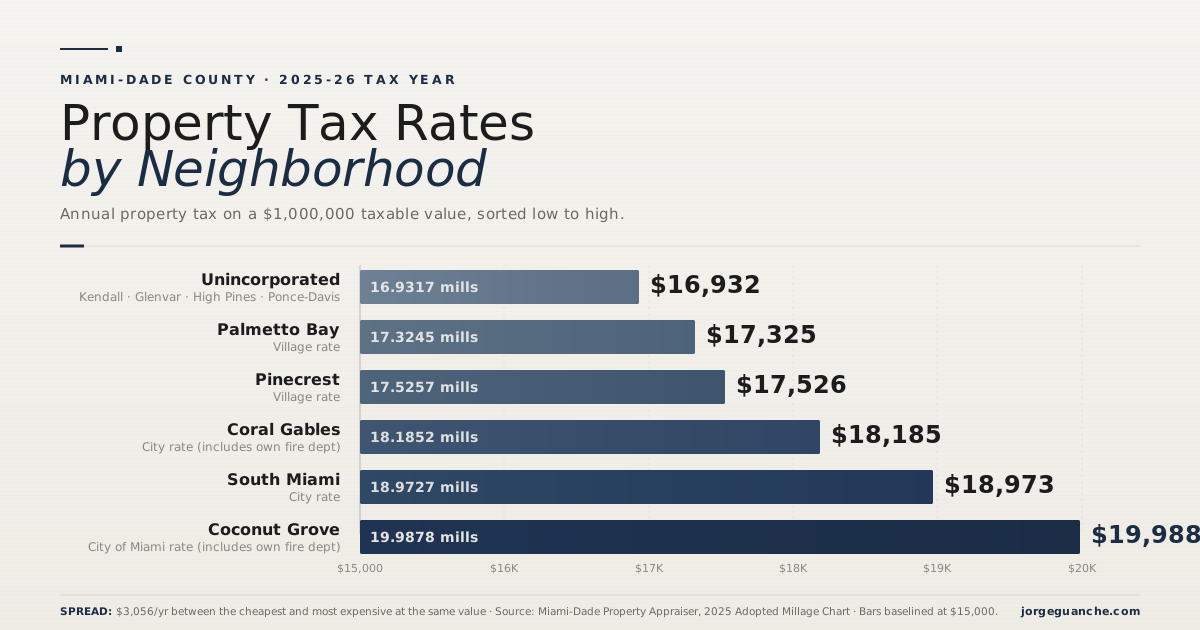
Three different offices touch your tax bill and they do different jobs. The Property Appraiser decides what your property is worth as of January 1. The taxing authorities listed on your notice, the county, the school board, your city, set their millage rates in September. A mill is one dollar of tax per thousand dollars of taxable value, so a combined 16.9317 mills is $16.93 per thousand, or about 1.69%. The Tax Collector sends the bill and takes the money.
This guide is about the first of those, a challenge to the value. The Value Adjustment Board also hears other specified disputes, including denials of exemptions and of agricultural or other classifications, denials of portability transfers and certain tax deferral and penalty matters, so if your issue is one of those, the Clerk's petition types cover it. What no petition reaches is the millage rate, the exemption amounts set by statute, the non-ad valorem assessments, which are the flat charges for things like solid waste and fire rescue that do not move with value, or the Save Our Homes cap percentage, no matter how unreasonable any of them feel (F.S. 194.301).
The board itself is independent of the Property Appraiser's office, and the Clerk of the Court and Comptroller runs it, according to the Clerk of the Value Adjustment Board. Rates differ a lot between Coral Gables, Coconut Grove, Pinecrest, South Miami, Palmetto Bay and unincorporated Miami-Dade, which I break down in the combined millage rate for your area.
How to read your Miami-Dade TRIM notice
Three things on the page matter: two value lines and one column almost everyone misreads.
Market value, assessed value, taxable value
Market value, which your notice and the statutes also call just value, is what the Property Appraiser thinks the property would have sold for on January 1, 2026. The two words mean the same number. Assessed value is that number after the cap is applied, either Save Our Homes on a homestead or the 10% cap on everything else. Taxable value is what is left after your exemptions come off, and that is the number the millage rate gets multiplied against.
The notice has to show all of those for both this year and last year (F.S. 200.069(6)(a)). You will see two assessed values rather than one. On non-homestead property the 10% annual cap on assessment increases (F.S. 193.1554) applies to every levy except the school district, so the school assessed value can run higher than the county and city figure. Exemptions are the next step, turning assessed value into taxable value, and the additional homestead exemption only comes off the non-school base. I cover that split in detail in how the homestead exemption and Save Our Homes work.
The three tax columns, and the one people misread
Across the middle of the notice are three dollar columns (F.S. 200.069(5)). Column 1 is what you paid last year and Column 3 is what you will pay if every authority adopts the rate it is proposing. Column 2 is the one people get wrong. It reads "Your Taxes This Year IF NO Budget Change Is Adopted," which sounds like last year's bill repeated, but it applies this year's value at the rolled-back rate, the rate that would raise the same total revenue as last year.
So Column 2 above Column 1 means your property gained value faster than the rest of the jurisdiction, and Column 3 minus Column 2 is the part that comes from the rate decision rather than from your value. Neither is appealable. Only the value is.
My value jumped a lot. Is that a problem?
Usually not by itself. The Property Appraiser re-runs every parcel each January 1, so a large move can simply mean the sales around you moved. A big jump isn't evidence of an error, and a small one isn't evidence the number is right.
What matters is the level, not the change. Two separate questions decide whether to file. The legal one is whether the January 1 value sits above what comparable sales support, because that is all the board rules on. The practical one is whether winning would actually reach the number you are taxed on. You need both, and most owners fail the second without ever getting to the first. On a homestead you have held for years, a dramatic jump in market value often changes your bill by nothing at all, for reasons the next section explains.
The one check that settles it for most owners
Find market value and assessed value on your notice and look at the distance between them. To move your bill a reduction has to be bigger than that gap. There is no cap on how far the board can cut a value, and a well-evidenced case can go further, but in ordinary residential appeals the comparable sales usually support something in the 5% to 10% range.
So my rule of thumb for a homesteaded property is this. If the gap is more than about 10% of your market value on both assessed values, a petition is unlikely to reach your bill. That is a screening heuristic I use to triage notices, not a legal threshold and not proof that a case cannot be won. A well-evidenced petition can produce a larger reduction than the comps usually support, and the board sets no limit on how far it can cut a value. If the gap is under 10%, or zero, a reduction would land on the number you are taxed on and it is worth pulling comps. The rule does not apply to a rental or second home, because on non-homesteaded property the school assessment is never capped, so a reduction always reaches the school portion of the bill even when the non-school assessment sits well below market. Those owners have the real cases, and the calculator below runs the two bases separately for exactly that reason. On a homestead bought in the last few years the gap is usually small too, so run the numbers rather than assuming Save Our Homes has you covered.
This calculator also lives at a standalone page you can bookmark or send with your notice.
If a reduction would not reach either taxable value, you're done. Skip to the last section for the one thing you can still do about a rising bill. If it would reach it, keep reading, because the next question is whether the value is actually too high.
Can an appeal backfire?
This is the question I get first and it's the easiest to answer. A petition asks the board to lower your value, and the board rules on the request in front of it, so the outcome is a reduction or nothing. The board does have authority to raise a market value, but only where an owner files asking it to, which is a separate and unusual filing. Filing doesn't invite a re-look at your exemptions and it doesn't put you on a list. The $15 is the only money at risk today. There is one case where winning can still cost you later, and it applies to long-held homesteads planning a move, which I cover under what an appeal does not do.
When an appeal is not worth filing
Three situations account for most of the petitions that were never going to work.
A long-held homestead usually has nothing to gain
On a homesteaded property, your assessed value is whichever is lower: the market value, or last year's assessed value plus the cap. The 2026 cap is 2.7%, according to the Florida Department of Revenue (F.S. 193.155(1) and (2)).
Round numbers make the problem obvious. Say your notice shows a market value of $1,077,000 and an assessed value of $513,500. You are taxed on the assessed number. To move your bill by even a dollar, you would have to prove the property is worth less than $513,500, which is a 52.3% cut to the county's opinion of value.
That is not a winnable argument. And you are not being overtaxed: Save Our Homes has already knocked more off your bill than any appeal realistically could, and it did it for free. For scale, the average successful residential appeal in tax year 2024 reduced county taxable value by $90,386, according to the county's Tax Impact of the Value Adjustment Board notice.
52.3%
How far the county's opinion of your value would have to fall before a long-held homestead owner saves a single dollar, in the example above. That is why most homestead owners should put the notice down.
Your neighbor's assessment is not evidence
The Miami-Dade Property Appraiser prints this as a heading on its own website: "Comparable assessments are not a basis to reduce the value of a property."
Two identical houses on the same block routinely carry very different assessed values, because the owners bought in different years and have accumulated different amounts of Save Our Homes protection. That is the system working as designed. Comparable sales are evidence. Your neighbor's assessed value is not, because it is a capped number carrying their purchase year rather than an opinion of what anything is worth. Sales are public: the Property Appraiser's own site lists them by folio, and you want arm's length sales of similar homes near you, closed as close to January 1 as possible.
The county starts out presumed right
The law assumes the Property Appraiser got it correct, as long as the office can show it followed the statutory valuation factors and standard appraisal practice (F.S. 194.301(1), Rule 12D-9.027(2)(a)). Once that is established, the burden is on you, and you have to outweigh the county's evidence to win (F.S. 194.301(2)). You are not walking in on even footing.
When a Miami-Dade appeal is worth filing
Both tests have to pass. On the law, the board asks one thing only, whether the January 1, 2026 value sits above what comparable sales support. The economic question is one the board never rules on, whether the gap between market value and assessed value is small enough that cutting the market value reaches your taxable value. A petition can win on the law and still save you nothing.
Both tests come down to comparable sales as of January 1, 2026. If you want that set pulled for your folio before you file, get in touch and I'll run it, classified by location the same way I build my quarterly market numbers.
You bought recently and the value came in high
When a property changes hands, the assessment resets to full just value on the following January 1 (F.S. 193.155(3)). That reset is the statute working as written and there is no appealing it.
What you can check is the number itself. The law defines value as what a willing buyer would pay a willing seller, and it specifically measures value net of the reasonable costs of sale (F.S. 193.011(1) and factor 8). In practice that puts a recent buyer's January 1 value nearer 85% of the price than the full price, so a value above what you paid is not the only trigger. If the January 1, 2026 value sits at or near your purchase price, your own closing statement is about the strongest evidence there is.
Rentals and second homes, where the cap did nothing
Second homes, rentals and investment property get a 10% annual cap on the non-school portion instead of Save Our Homes, with school levies uncapped, and assessed value can never exceed just value (F.S. 193.1554(3) and (4)).
In practice that cap often does nothing at all. Take a parcel where last year's assessed and just values were both $800,000. If market value rises 8%, a round number used only to show the arithmetic, the cap would allow $880,000 but just value is only $864,000. The lower number wins, so the cap never came into play.
That is exactly the situation where an appeal pays. When assessed value and just value are the same number, every dollar you knock off the value is a dollar off what you are taxed on. This group has more to gain than anyone.
The Miami-Dade property tax appeal success rate
About a third of residential appeals succeed
In tax year 2024, Miami-Dade owners asked for 41,942 residential assessment reductions and the board granted 14,856, a 35.4% success rate, according to the county's Tax Impact of the Value Adjustment Board notice. Across all property types the rate was 44.2%, so residential is the harder track.
Call it roughly a third and hold it loosely. Another 15,887 petitions were withdrawn or settled before any ruling and the county reports them as one figure, so the true rate could land anywhere from about a quarter to above half.
The arithmetic on a contingency fee
Appeal firms advertise heavily in August. An average successful appeal saves about $1,530 in year one, and the fee agreements I have seen run 25% to 35% of that plus $25 to $125 up front, so hiring out costs you roughly a third of the win. Those are illustrative fee terms rather than a published standard, so get the actual agreement in writing. The useful way to think about the trade is how much more often a firm would have to win to earn that share. What I cannot tell you is how much more often they do win: the county publishes one countywide residential success rate across all petitions, owner-filed and firm-filed together, and none of the four firms I checked publishes its own.
| How you file | Success rate it has to reach to beat filing yourself |
|---|---|
| File it yourself on the DR-486 | 35.4%, the 2024 countywide residential average across all petitions |
| 25% contingency plus $25 up front | 49.4% |
| 35% contingency plus $45 up front | 59.0% |
| 33% contingency plus $125 up front, an illustrative fee agreement | 65.0% |
Set the up-front fees aside and the contingency alone means a 33% firm would have to win about one and a half times as often as you do to break even, and a 25% firm about a third again. Add the up-front money back and you get the table above. The multiplier holds whatever the real success rates turn out to be, which is why it is the number to trust here, and it is not a claim that firms win more or less often than owners. None of the four firms I checked publishes a rate, so ask on the phone, and treat an answer with no year attached as no answer. A high-value property with a genuine overassessment can save many times $1,530, and a firm that wins it earns its share.
Ask the Property Appraiser for an informal review
Before you file anything, you can just call and ask. This is a statutory right rather than a favor. The Property Appraiser or a staff member "shall confer with the taxpayer regarding the correctness of the assessment" (F.S. 194.011(2)).
Miami-Dade handles it through an Informal Assessment Review Form, which asks for your opinion of market value as of January 1 plus comparable sales with address, price, date and folio. The office promises a status update within five business days.
One warning, and it is the reason people miss the deadline. The informal review doesn't pause anything. As the state's own form puts it, the conference "is not required and does not change your filing due date," and the county's review form carries no warning that the clock is still running. If your numbers suggest a real case, request the review and file the petition anyway. You can withdraw later without penalty, though the $15 is gone either way, and a missed deadline is very hard to recover from. The board can hear a late petition only on a showing of good cause, which Rule 12D-9.015(14) of the Florida Administrative Code defines as a verifiable showing of extraordinary circumstances, and the Clerk routes late filings to a separate good cause hearing before the appeal itself is considered.
How to appeal your Miami-Dade property taxes, step by step
If you have cleared both tests, the whole process runs as follows.
Filing the petition
| Item | Detail |
|---|---|
| Regular 2026 deadline | September 18, 2026, now passed. Florida law sets the window at 25 days from the mailing of the notice (F.S. 194.011(3)(d)). Ask the Clerk about late filing or the next cycle |
| Form | Florida DOR form DR-486, revision R. 12/25. Use the DR-486PORT if you are appealing a denied portability transfer |
| Fee | $15 per folio, nonrefundable. It drops to $5 per folio on joint petitions, which condominium, cooperative and homeowners' associations can file, as can owners of adjoining undeveloped parcels (F.S. 194.011(3)(e) and (f)) |
| File online | vabprod.miamidade.gov |
| File by mail or in person | Clerk of the Value Adjustment Board, Stephen P. Clark Center, 111 NW First Street, Suite 1720, Miami, FL 33128 |
One petition covers one issue. If you are disputing two things, the DR-486 tells you to file separately for each. And an exemption denial runs on its own clock, 30 days from the date that denial was mailed rather than from the TRIM date (F.S. 194.011(3)(d)).
The two evidence deadlines
Your evidence is due twice, to two different offices. A list and summary of it, with copies, goes to the Property Appraiser at least 15 calendar days before your hearing. The same evidence goes to the Clerk's AXIA system by 9:00 a.m. the day before.
One thing changed recently and it works in your favor. As of September 1, 2025, the exchange is mandatory and runs both ways, so the Property Appraiser now has to hand over its evidence to you without any preconditions (Chapter 2025-208, Laws of Florida). Tax year 2026 is the first full cycle under that rule, which means a homeowner filing alone gets to see the county's file before the hearing without having to ask. The DR-486 also has a checkbox letting the board consider your evidence if you would rather not attend.
The payment rule that quietly kills petitions
This one catches people. If your appeal is still pending when taxes go delinquent, you have to have paid at least 75% of the ad valorem taxes plus all of the non-ad valorem assessments, less discounts (F.S. 194.014). For tax year 2026 that means paying by March 31, 2027.
The statute leaves no room: the board "must deny the petition by written decision by April 20 if the petitioner fails to make the payment required by this subsection." A special magistrate's recommendation does not count as a final decision and does not get you out of it. Most owners pay in full in November and never come near this, but if you are holding payment while you appeal, mark the date.
What an appeal does not do
A win resolves one tax year and nothing beyond it. The Property Appraiser reassesses market value every January 1, and nothing binds the office to a value the board set last year.
What does carry forward is the arithmetic. If you get the assessed value reduced, next year's cap is calculated off that lower number, so the saving compounds quietly. If you only get market value reduced on a property whose assessed value already sits far below it, nothing carries at all.
An appeal cannot change the Save Our Homes rules or the $500,000 cap on portability and the DR-501T, but it can shrink the number those rules get applied to. Your Save Our Homes benefit is the difference between market value and your capped assessed value, and that same difference is what you carry to your next Florida homestead. Win a market value reduction on a long-held homestead and the benefit shrinks by what you won, while your current bill does not move at all. If a Florida move is anywhere on your horizon, leave a wide gap alone. Taking a run at it is not the harmless move it looks like.
Before a Florida move, I compare the current benefit with the proposed new home in my Save Our Homes portability calculator.
And it does nothing for a buyer. When a property sells, the assessment resets to just value the following January 1 regardless of anything the board decided (F.S. 193.155(3) and F.S. 193.1554(5)). A seller cannot market a low tax bill, and a seller's appeal in the year of the sale is worth close to nothing to whoever buys it.
If you cannot appeal, this is the lever you still have
An appeal only reaches your value. The other half of your bill is the rate, and that gets set in public. Your TRIM notice prints the date, time and address of every taxing authority's budget hearing, usually in September, and they are open to anyone. That is the only room where the millage is actually decided, and almost nobody shows up. If your bill jumped and the gap says a petition is pointless, that is the meeting that matters.
If your gap is narrow and the value looks high, request the informal review and file the petition the same day. You can withdraw later. A late petition needs a good cause finding under Rule 12D-9.015(14), which means extraordinary circumstances you can document, so treat the published deadline as final.
Two things I'm glad to do either way. If you think you have a case, I will pull the recent sales around your address, classified by map location rather than by neighborhood label, and tell you straight whether the county's number is out of line. And if the county just told you your house is worth something that surprised you, I'll tell you whether that number is real, which is a different and usually more interesting question. Text or call 786.223.1117, or send me the address.
Sources and methodology
Jorge Guanche, comparable sales classified by mapped location rather than by MLS neighborhood label. See my data sources and methodology.
Jorge Guanche, Miami-Dade Property Tax Rates by Neighborhood, 2025-26 Combined Millage Guide
Miami-Dade County Property Appraiser, Notice of Proposed Property Taxes (TRIM Notice)
Miami-Dade County Property Appraiser, Appealing Your Assessment
Miami-Dade County Property Appraiser, Property Value
Miami-Dade County Property Appraiser, Property Value Changes
Miami-Dade County Property Appraiser, Informal Assessment Review Form
Clerk of the Value Adjustment Board, Miami-Dade County
Public Notice, Tax Impact of the Value Adjustment Board, Miami-Dade County, Tax Year 2024
Florida Department of Revenue, Form DR-486, R. 12/25
Florida Department of Revenue, Uniform Policies and Procedures Manual for Value Adjustment Boards, Aug 2025
Florida Department of Revenue, Save Our Homes, revised Jan 2026
Florida Statutes 193.011, Factors to consider in deriving just valuation
Florida Statutes 193.155, Homestead assessments
Florida Statutes 193.1554, Assessment of nonhomestead residential property
Florida Statutes 194.011, Assessment notice and objections
Chapter 2025-208, Laws of Florida (HB 7031), section 7, amending F.S. 194.011 effective September 1, 2025
Florida Statutes 194.014, Partial payment of ad valorem taxes
Florida Statutes 194.037, Disclosure of tax impact
Florida Statutes 194.301, Challenge to ad valorem tax assessment
Florida Statutes 200.065, Method of fixing millage
Florida Statutes 200.069, Notice of proposed property taxes and non-ad valorem assessments
Four Miami-Dade property tax appeal firms, published fee schedules, retrieved Aug 2026. Firms not named; fee ranges reported in aggregate.