Neighborhood Boundaries
Coral Gables
Interactive map of Coral Gables and six surrounding Miami-Dade neighborhoods. Use the links below the map to open any neighborhood guide.
Neighborhood Overview
Living in Coral Gables
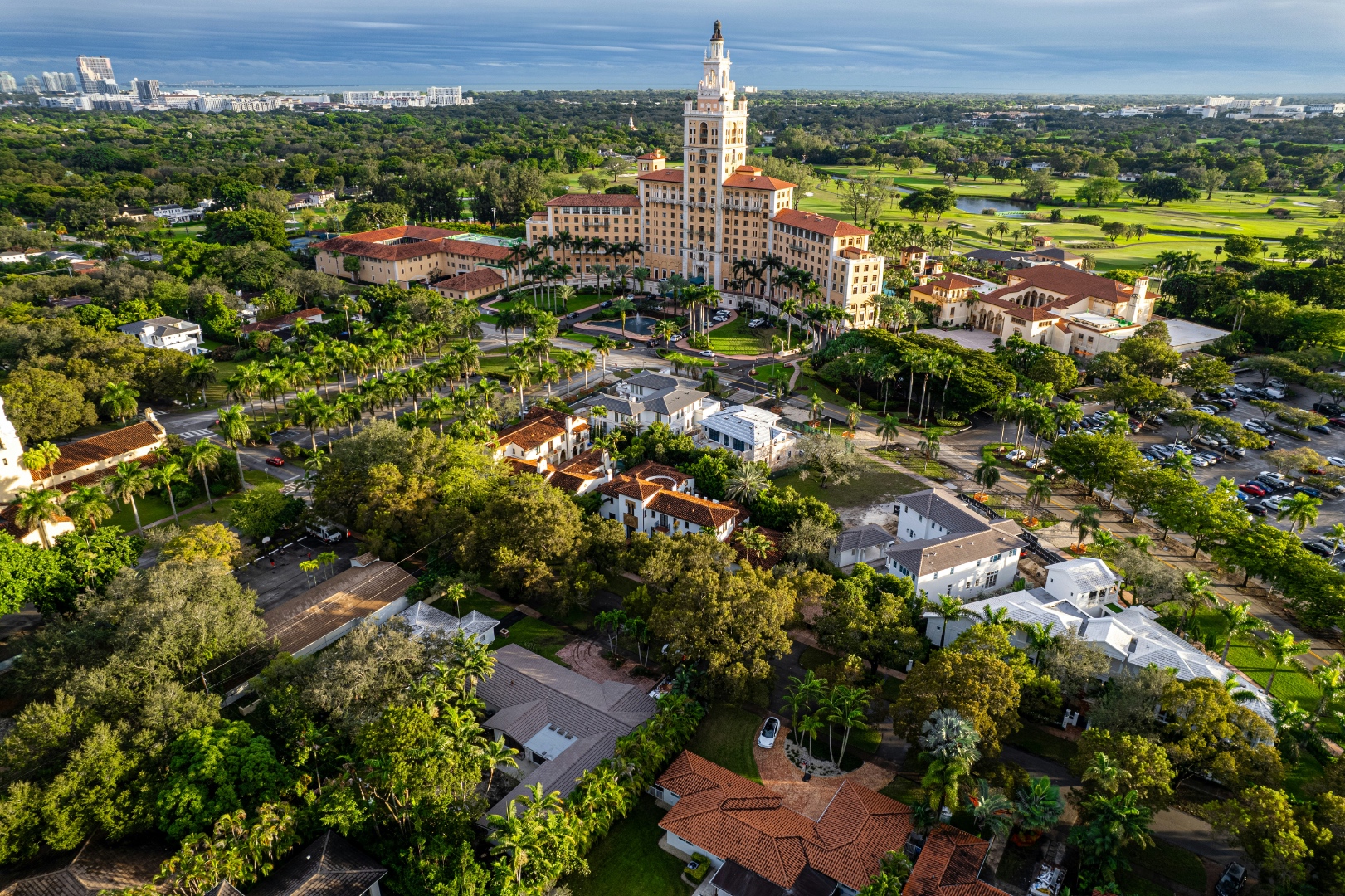
Coral Gables was laid out in the 1920s by George Merrick as a planned city. Nearly a century on, the plan is still intact. Mediterranean Revival homes on oak-canopied streets, zoning strict enough to keep the scale from drifting, and 12.93 square miles that hold together as one of the most architecturally consistent residential markets in South Florida.
The Biltmore, Venetian Pool, Miracle Mile, and Fairchild Tropical Botanic Garden all sit inside city limits. The University of Miami anchors the corridor's economy. Coral Gables Preparatory Academy grades 10/10 and Sunset Elementary grades 10/10, and private options (Ransom Everglades, Gulliver Prep) are a short drive from most zip codes inside the city.
Buyers here pay for a city that protects its architectural standards. After two decades in this market, I see that protection as where the long-term value sits.
Coral Gables pricing lives in the Board of Architects record, the permit history, Miracle Mile proximity, and the school zoning map. A historic estate on the signature boulevards runs on different math than a smaller home zoned into the top public schools. I work those layers before the first showing.
Coral Gables Real Estate Market Snapshot
Updated Q3 2026
Closed sales (Q3 2026 vs Q3 2025)
| Metric | Q3 2026 | YoY |
|---|---|---|
| Median sold price | $2,102,500 | +12.1% |
| Median $/SF | $923 | +3.0% |
| Median days to contract | 40 days | -4 days |
| Closed sales | 96 | +1.1% |
Active inventory (as of October 4, 2026)
| Metric | Value |
|---|---|
| Active single-family listings | 162 |
| Median list price | $3,537,500 |
| List price range | $489,000 to $148,000,000* |
| Under contract | 47 |
Single-family homes reassigned to Coral Gables by mapped location. Closed figures Q3 2026 vs Q3 2025. Active inventory as of October 4, 2026, excluding Coming Soon and Private Exclusive listings; under contract includes pending, active-with-contract and active-under-contract listings. *The top of the list price range is one $148,000,000 listing, an outlier. The next-highest asks $78,000,000, and one listing barely moves the median list price. Source: SE Florida MLS, polygon-classified. Full Q3 2026 market report for all 8 neighborhoods.
Market Intelligence
Market Analysis: Single-Family Homes
Each sale on this page is counted where the parcel actually sits inside the City of Coral Gables boundary, whatever neighborhood the listing agent typed in (how I do it).
What You Will Actually Pay
Over the past twelve months, 441 single-family homes sold inside the city at a $2,175,000 median, and the middle half of those sales landed between about $1.4 million and $3.65 million. Fewer than one in ten closed under $1 million (35 sales), and 30 closed at $10 million or more.
Where a house sits within the city moves those numbers more than anything else. In 33134, the northern end of the city and the source of about half the sales (218), the middle half ran from about $1.2 million to $2.45 million around a $1.6 million median. In 33146, the center of the city around the University of Miami, 110 sales had a $2.28 million median and a middle half of $1.6 million to $3.5 million. In the southern zip codes, 33143 and 33156, the 83 sales had a $6 million median, with the middle half running from about $3.45 million to $10.7 million.
Within any of those bands, the price of a specific house turns on its school zone, whether it fronts water, what the Board of Architects and historic-preservation record allows, and how far it sits from Miracle Mile and the University of Miami. Before you make an offer, I build the comparable set for the street and school zone you are buying into.
What I Tell My Clients
Coral Gables gives me more recent sales to work with than any other area I cover, so I can usually price a house from sales on the same few blocks. I lean on those sales because the citywide median shifts with the mix of homes that closed in a quarter, and the same mix can pull it away from price per square foot.
With 5.1 months of supply as of October 4, buyers have room to negotiate on homes that have sat, and a seller who prices to the recent closings gives buyers a reason to act. If you plan to renovate, treat Board of Architects review as a real cost and a scheduling factor, and confirm what your project needs before you commit to a scope.
Competitive Analysis
How Coral Gables Compares
Coral Gables ranks third of the eight areas on median price at $2,102,500, behind Pinecrest and Coconut Grove, and second on price per square foot at $923, behind only the Grove. It closed more sales than any other area, 96 in the third quarter, and tied Glenvar Heights for the quickest pace at 40 days to contract. Its 3.0% per-foot gain was the second smallest of the seven measurable areas, just above Palmetto Bay's 2.9%. The closest comparison on price is Pinecrest, where homes and lots run larger and sold for about $90 less per square foot.
Median price per square foot, single-family homes, each sale classified by mapped location. Basemap © OpenStreetMap contributors. Full Q3 2026 report.
| Neighborhood | Median sold | YoY | $/SF | Days to contract | Closed |
|---|---|---|---|---|---|
| Pinecrest | $2,900,000 | +14.4% | $832 | 43 | 63 |
| Coconut Grove | $2,800,000 | +21.7% | $1,245 | 45 | 57 |
| Coral Gables | $2,102,500 | +12.1% | $923 | 40 | 96 |
| Glenvar Heights | $1,810,000 | +4.6% | $823 | 40 | 17 |
| South Miami | $1,391,500 | +10.9% | $738 | 43 | 22 |
| Kendall | $1,200,000 | +13.5% | $496 | 41.5 | 93 |
| Palmetto Bay | $1,200,000 | +9.4% | $502 | 41 | 87 |
| High Pines + Ponce-Davis | n/m | n/m | n/m | n/m | 3 |
Source: MLS closed single-family sales, reassigned to true neighborhood boundaries by parcel location. Q3 2026 vs Q3 2025. High Pines + Ponce-Davis had 3 sales, too few to measure, so it is shown without figures. Glenvar Heights (17) and South Miami (22) are small samples. n/m = not meaningful.
Why Coral Gables
The Value Proposition
Coral Gables runs its own police and fire departments, and alterations here can involve architectural, zoning and historic-preservation review, depending on the property and the work. The city's design guidance accommodates several architectural styles, with specific incentives for Mediterranean design.
Against Pinecrest, the Gables trades scale for location, with less than half the lot size (a 10,000-square-foot median lot here) inside the Biltmore, University of Miami and Miracle Mile perimeter. For an estate lot at lower density, Ponce-Davis and High Pines run the unincorporated mile just south of the city on the same 33143 footprint.
My own Coral Gables sales include 3601 Durango St in the Country Club Section, sold for $1.77M, and 626 Coral Way, Unit 305 in Central Gables, sold for $1.06M.
If you are also considering Coconut Grove, Pinecrest or High Pines + Ponce-Davis, compare the homes and approval requirements rather than the area medians alone.
If you are buying here to renovate, the approval path matters as much as the price. Send me the property and we can work out what review it triggers and what to ask the city's development staff before you settle on a scope. Discuss this property.
Know the Pockets
Subdivisions & Micro-Neighborhoods
Coral Gables is not one market. It is a set of them, and the spread between them is wide. The citywide median means little until you know which of these a home sits in.
The guard-gated waterfront communities. The top of the Gables market is a cluster of guarded, waterfront enclosures with direct or near-direct ocean access, and they trade on their own comps far above the citywide median.
Gables Estates is the most exclusive of them, roughly 192 lots on more than 200 acres of shoreline with deep-water, bridge-free access to Biscayne Bay. Guarded gates and patrols.
Cocoplum covers more than one community, and the difference matters. The Islands of Cocoplum association counts 302 homes, a large share of them waterfront, and runs the private clubhouse, tennis and yacht basin. A separate 150-home Cocoplum community sits outside that association and does not have access to those facilities. Both are guard-gated. Confirm which association a property belongs to, and what amenity rights come with it, in the governing documents.
Tahiti Beach is a guarded, invitation-only subdivision of Islands of Cocoplum with a sandy beach. Its 27 homes are counted within the 302 rather than added to them. A yacht basin nearby is not the same as a slip, so confirm any marina or boat-slip arrangement for the specific property.
Old Cutler Bay is a guard-gated community of roughly 136 homes on Biscayne Bay, with wide canals and no-bridge ocean access.
Journey's End is a small guarded community of about 18 estate homes on two-plus-acre lots, with a private marina and bridge-free bay access.
Snapper Creek Lakes is a gated estate community with lake frontage and its own channel to open water.
Gables by the Sea is a gated, canal-front community with ocean access and a wider band of price points than the estate enclosures above.
At this tier the analysis changes. Waterfront depth, dock and bridge clearances, seawall condition, and flood and insurance exposure drive value as much as the house does, and I underwrite those directly rather than leaning on the citywide median.
The lakefront and interior estate pockets. Hammock Lakes, off Old Cutler Road, is a gated lakefront community with large lots, generally in the 30,000 to 77,000 square foot range, on fresh water rather than ocean access. The Riviera district, west of the Biltmore and near the University of Miami, wraps the private Riviera Country Club, an 18-hole Donald Ross course dating to the 1920s, and offers established, non-gated streets close to campus and downtown.
The broader city fabric. Away from the gated communities, most of Coral Gables is the classic Merrick grid: Mediterranean Revival and mission-style homes on oak-lined streets, on lots that run smaller than the estate pockets, with the standard Gables lot closer to a quarter acre. Buyers and agents often talk informally about the North Gables and the South Gables, loosely split by the US-1 corridor, but those are not official city designations, and I would not lean on them as though they carried a formal boundary. What matters is the specific plat, the school zone, and the block-level architectural record.
Education
Schools & Education
Coral Gables is served by Miami-Dade County Public Schools, and the public options inside the city run strong, with several magnet programs layered on top of the neighborhood schools.
Elementary. Coral Gables Preparatory Academy grades 10/10 on GreatSchools and is one of the higher-rated public elementary options in the county. Sunset Elementary runs a long-standing International Studies magnet, a dual-language program partnered with France, Germany, and Spain, and grades 10/10. Henry S. West Laboratory School, a K-8 magnet historically tied to the University of Miami's School of Education, also enrolls students from the city. School assignment depends on the property address, and magnet programs have separate application and admission requirements.
Middle. George Washington Carver Middle School grades 10/10 and runs the International Studies magnet, which students apply into. Ponce de Leon Middle graded B from the state for 2025-26 and offers the International Baccalaureate Middle Years program. Because several of these are magnets, enrollment can run on application or lottery rather than pure address, so I always confirm the current assignment and magnet-admission rules for a specific home rather than assuming the zoned school.
High school. Coral Gables Senior High, "Gables," is an International Baccalaureate magnet with an established IB Diploma Programme and Advanced Placement offerings. Buyers weighing the public high-school path should look at the IB and magnet admissions specifically rather than the blended composite rating, since the magnet program and the general-enrollment school are effectively two different tracks under one roof.
Private and independent. Gulliver Preparatory's Marian C. Krutulis PK-8 campus is at 12595 Red Road in Coral Gables. Its upper school is at 6575 North Kendall Drive in Pinecrest. St. Theresa (Little Flower), a Catholic PreK-8 school, is inside the city. Two of the region's best-known independents, Ransom Everglades and Carrollton School of the Sacred Heart, are a short drive away in neighboring Coconut Grove rather than in the Gables itself. The University of Miami's main campus is in Coral Gables, which puts a major research university, its cultural calendar, and its economic pull inside city limits.
GreatSchools ratings refresh on a cycle, so I verify the current number for a specific address at the time of a purchase rather than relying on a static figure. For a buyer choosing primarily on schools, the school zone and magnet-admission status are as material to the decision as the house.
Daily Life
Lifestyle & Community
Coral Gables gives you a walkable, low-rise city core wrapped around residential streets, which is uncommon in Miami-Dade. Most of the daily-life anchors sit within the city or right on its edge.
Retail and dining. Miracle Mile, the stretch of Coral Way between Douglas and LeJeune, is the downtown retail and dining spine and came through a major streetscape redesign that widened the sidewalks and reset the tree canopy. A block over, Giralda Plaza is a pedestrianized dining row that reopened to foot traffic in 2017. The Shops at Merrick Park, an open-air luxury center on Ponce de Leon Boulevard, is anchored by Nordstrom and Neiman Marcus. Between the three, a Gables resident can cover everyday retail, restaurants, and high-end shopping without leaving the city.
Parks, culture, and landmarks. The Venetian Pool, cut from a 1920s coral rock quarry and on the National Register of Historic Places, is a public swimming landmark unlike anything else in the county. The Biltmore Hotel, opened in 1926 and a National Historic Landmark, is the architectural signature of the city and marked its centennial in 2026. On Old Cutler Road, inside the city's southern reach, Fairchild Tropical Botanic Garden and Matheson Hammock Park give residents a large botanical garden and a bayfront county park with a man-made atoll pool minutes from home. In the core, the Coral Gables Museum occupies the restored 1939 police and fire station on Aragon Avenue, next to the flagship Books & Books, the independent bookstore Mitchell Kaplan opened in 1982.
The practical feel. What you get living here is a residential city that runs on its own codes. The scale stays low, the streets stay canopied, and the commercial cores stay contained to defined corridors instead of bleeding into the neighborhoods. Coral Gables also runs its own police and fire departments, which is part of why the municipal tax layer exists and part of why service levels hold up. For the buyer who wants an urban core within walking or short-drive distance of the house, without a high-rise skyline over the backyard, that combination is the draw.
Getting Around
Transportation & Access
Coral Gables sits in the middle of Miami-Dade's job geography, with road and transit connections to several employment centers.
Roads. LeJeune Road (SW 42nd Avenue) runs north to Miami International Airport, and US-1 (South Dixie Highway) is the main artery toward downtown and Brickell to the northeast and Pinecrest and the southern suburbs to the south. From the Miracle Mile core, downtown Miami and Brickell are roughly six to seven miles out, about 15 to 20 minutes in typical non-rush-hour traffic. MIA is roughly seven miles north, again about 15 to 20 minutes off-peak up LeJeune. Rush hour adds meaningfully to both, so I treat these as light-traffic baselines rather than promises.
Transit. Two Metrorail stations serve the city on the line that runs up to downtown, the government center, and the airport connector: University station at the University of Miami on Ponce de Leon Boulevard, and Douglas Road station at SW 37th Avenue and US-1 on the city's northeast edge. That gives Gables residents a genuine rail option into downtown and to the MIA intermodal center, which is rare for a low-rise residential city. Inside the Gables, the free city trolley runs weekday and Saturday routes connecting the Douglas Road Metrorail station through the downtown core, so the last mile from rail to Miracle Mile is covered without a car.
For a buyer weighing a commute, Coral Gables is close to the region's two biggest destinations, the Brickell financial core and the airport, on both road and rail, and that access is priced into the land.
Client Experience
What Buyers & Sellers Say
Over 100 five-star reviews across Google, Zillow, and more
Jorge helped my partner and I find our dream apartment in the Gables! He made the process super easy and fun. Thank you, Jorge!
Jorge helped us with the sale of our home in the Gables a few months ago and from beginning to end the experience was exceptional.
Common Questions
Frequently Asked Questions
Coral Gables single-family homes closed at a $2,102,500 median in Q3 2026 across 96 sales, up 12.1% from Q3 2025. Median price per square foot was $923, and the median home went under contract in 40 days. Over the past twelve months the median was $2,175,000 across 441 sales. Source: the site's polygon-classified MLS analysis. These describe the homes that sold; differences in location, condition, size, land and construction mix can affect the figures. They are not an appraisal of a particular home.
Source: Market methodology
Coral Gables is known for George Merrick's 1920s city plan and its Mediterranean Revival architecture, still intact across 12.93 square miles, along with the Biltmore Hotel, the Venetian Pool and Miracle Mile. The city reviews alterations through its architectural and historic-preservation process, though its design guidance accepts more than one style.
Coral Gables Preparatory Academy and Sunset Elementary both rate 10/10 on GreatSchools, George Washington Carver Middle, also 10/10, runs an International Studies magnet that students apply into, and Coral Gables Senior High is an International Baccalaureate magnet. Gulliver's PK-8 campus is in Coral Gables and its upper school is in Pinecrest. Assignment depends on the address and the magnets admit by application, so confirm both with M-DCPS.
Source: Find Your Neighborhood School, M-DCPS parents, Gulliver campuses, Coral Gables Prep conversion, Sunset programs, GreatSchools: Henry S. West Laboratory, GreatSchools: George Washington Carver Middle
It is if you want an established city with its own police and fire departments, Miracle Mile within reach and two Metrorail stations, and you accept review requirements on alterations. Lots run smaller than in Pinecrest or Glenvar Heights, with a 10,000-square-foot median. If you plan to renovate, check the zoning, any historic designation and the approvals the project needs before you buy.
Source: Gables development FAQ, Gables design guidance, County flood property checks, Market methodology
Call Jorge Guanche at 786-223-1117 or use the contact form on this page. His Coral Gables sales include 3601 Durango St in the Country Club Section, and before you price or offer he compares the street-level sales, the competing listings and the Board of Architects questions for the specific property. Jorge Guanche is a Compass agent ranked in the Top 1.5% nationwide by RealTrends, with 20+ years of experience across Coral Gables and surrounding neighborhoods and over 100 five-star reviews.
The 2026-27 combined rate in Coral Gables is 18.1518 mills, which includes the city's own fire department. What a buyer pays also depends on taxable value: for eligible 2026 homesteads, Florida lists a first $25,000 exemption and an additional inflation-adjusted $26,411 exemption that does not apply to school taxes. The seller's current bill is not a forecast of yours, because the assessment resets after a sale.
Source: Florida 2026 exemptions, Combined millage by neighborhood
Prices rose and supply sits in the balanced range. Coral Gables single-family homes closed at a $2,102,500 median in Q3 2026, up 12.1% from Q3 2025, on 96 closings, the most of the eight areas on this site. Price per square foot rose a smaller 3.0%, to $923, even though the typical home sold was smaller than a year earlier (1,992 square feet against 2,366). With the two measures moving this far apart, I price from comparable sales and lean on neither alone. As of October 4, 2026 there were 162 active listings and 47 under contract, 5.1 months of supply, which I read as balanced.
Source: Market methodology
Location, housing stock and architectural review all push it up, though no published median can say how much each contributes. The city holds the University of Miami, Miracle Mile and the Biltmore, much of its housing is older Mediterranean Revival stock under architectural review, and its lots run less than half the size of Pinecrest's. The Q3 2026 median was $923 per square foot, against $832 in Pinecrest and $823 in Glenvar Heights.
Source: Gables development FAQ, Gables design guidance, Market methodology
Most of Coral Gables sits in Zone X, with 15% of its single-family homes in a FEMA high-risk flood zone, rising to 16% on the new maps effective Feb 19, 2027. The risk runs north to south: 1% of homes north of SW 56th Street (Miller Road) are in a high-risk zone, against two in three south of SW 88th Street along the bay. Hurricane Andrew's bay surge in 1992 produced more than half of the city's flood claims. A typical high-risk policy costs about $2,132 a year, and the city's Community Rating System class takes 25% off eligible flood policies.
No. Coconut Grove costs more per square foot. Over Oct 2025 - Sep 2026, single-family homes in Coral Gables sold for a median $925 per square foot under air, against $1,117 in the Grove. The Gables gives you more land, with a median lot of 10,000 square feet against about 7,400 in the Grove, more homes under $1.5 million and a lower combined tax rate, 18.1518 mills against 19.9544.
How I source and verify the data behind this analysis → Data & Methodology
Direct Line
Ask About Coral Gables
Historic zoning, lot rules, and price bands vary by street. Send me what you're weighing and I'll reply personally.