Neighborhood Boundaries
South Miami
Interactive map of South Miami and six surrounding Miami-Dade neighborhoods. Use the links below the map to open any neighborhood guide.
Neighborhood Overview
Living in South Miami
South Miami is a 2.3-square-mile city along the US-1 corridor, bordered by Coral Gables, Glenvar Heights, and the University of Miami campus. In a footprint that small, centrality is the defining feature, and walkability compounds it.
Sunset Drive is the city's main artery, lined with restaurants, shops, and services that make the everyday walkable. The Cambridge Lawns historic district preserves a 1920s architectural pocket, and newer construction fills in around it, so the housing stock spans eras. South Miami Hospital and the UM campus are both within walking or biking distance of most residential streets.
Schools are a primary draw. Sunset Elementary (10/10) and South Miami K-8 Center (7/10) are well regarded, Ludlam Elementary grades 8/10, and South Miami Senior High handles the secondary level. Metrorail access at the South Miami Station sits on top of that, which is an option most Southwest Miami-Dade communities don't have.
Single-family homes here sell well below Coral Gables prices next door, and the city has its own Metrorail station and a walkable downtown. My office is on Sunset Drive, which keeps this market as my daily beat and lets me work at the block and micro-neighborhood level when clients are comparing specific streets.
South Miami Real Estate Market Snapshot
Updated Q3 2026
Closed sales (Q3 2026 vs Q3 2025)
| Metric | Q3 2026 | YoY |
|---|---|---|
| Median sold price | $1,391,500 | +10.9% |
| Median $/SF | $738 | +4.2% |
| Median days to contract | 43 days | -4 days |
| Closed sales | 22 | +22.2% |
Active inventory (as of October 4, 2026)
| Metric | Value |
|---|---|
| Active single-family listings | 30 |
| Median list price | $1,750,000 |
| List price range | $685,000 to $6,350,000 |
| Under contract | 14 |
Single-family homes reassigned to South Miami by mapped location. Closed figures Q3 2026 vs Q3 2025. With 22 closings in the quarter, the median moves with whichever homes happened to sell, so read the 10.9% change as a direction. Active inventory as of October 4, 2026, excluding Coming Soon and Private Exclusive listings; under contract includes pending, active-with-contract and active-under-contract listings. Source: SE Florida MLS, polygon-classified. Full Q3 2026 market report for all 8 neighborhoods.
Market Intelligence
Market Analysis: Single-Family Homes
Every figure on this page counts only sales whose mapped location falls inside the City of South Miami's limits, whatever neighborhood the listing names (how I count them).
What You Will Actually Pay
Over the past twelve months, 105 single-family homes closed inside the city at a $1,185,000 median, and the age and size of the house explain most of the spread around that number.
The lower quarter of sales closed below about $785,000. Most of those were houses under 1,500 square feet built before 1960, the city's original postwar stock. The middle half ran from about $785,000 to $1.83 million at a median of roughly 1,770 square feet. Two-thirds of those homes also date from before 1960, so additions, updates and lot size account for much of the range.
The top quarter starts near $1.85 million. Twelve of those sales were new construction built in 2022 or later, closing between $2.35 million and $7.35 million, with a median near $5.8 million for about 4,600 square feet. The rest were older homes, mostly larger ones, at $1.85 million to about $3.5 million. Lots stay modest, around 10,080 square feet at the median, so in South Miami you are buying the address and the walk to Sunset Drive more than land.
What I Tell My Clients
In a city this small, I price from individual sales on nearby blocks, and the first question is which side of the renovation line a house sits on, because that splits the market more than any median does. For a seller, condition and the first list price carry extra weight, since the pool of buyers for a given street is small and notices a dated or overpriced house quickly. Supply stood at about 4.1 months in early October, just inside the four-to-six-month range I treat as balanced. For a buyer, I confirm the house is inside city limits before anything else, since a South Miami mailing address does not settle it, and then check the school assignment for that exact address.
Competitive Analysis
How South Miami Compares
South Miami sits in the middle price tier of the eight areas I cover, above Kendall and Palmetto Bay and one step below Glenvar Heights, its neighbor to the west. Per square foot it lands much closer to Glenvar than to Kendall or Palmetto Bay, on smaller houses, about 1,750 square feet at the median over the past twelve months. Its pace to contract is in line with the group. With only 22 sales in the quarter, read the year-over-year change as a direction; three of those sales were new construction, against none in Q3 2025.
Median price per square foot, single-family homes, each sale classified by mapped location. Basemap © OpenStreetMap contributors. Full Q3 2026 report.
| Neighborhood | Median sold | YoY | $/SF | Days to contract | Closed |
|---|---|---|---|---|---|
| Pinecrest | $2,900,000 | +14.4% | $832 | 43 | 63 |
| Coconut Grove | $2,800,000 | +21.7% | $1,245 | 45 | 57 |
| Coral Gables | $2,102,500 | +12.1% | $923 | 40 | 96 |
| Glenvar Heights | $1,810,000 | +4.6% | $823 | 40 | 17 |
| South Miami | $1,391,500 | +10.9% | $738 | 43 | 22 |
| Kendall | $1,200,000 | +13.5% | $496 | 41.5 | 93 |
| Palmetto Bay | $1,200,000 | +9.4% | $502 | 41 | 87 |
| High Pines + Ponce-Davis | n/m | n/m | n/m | n/m | 3 |
Source: MLS closed single-family sales, reassigned to true neighborhood boundaries by parcel location. Q3 2026 vs Q3 2025. High Pines + Ponce-Davis had 3 sales, too few to measure, so it is shown without figures. Glenvar Heights (17) and South Miami (22) are small samples. n/m = not meaningful.
Why South Miami
The Value Proposition
South Miami gives up lot size for location. The median lot is about 10,080 square feet, close to Coral Gables and well below Glenvar Heights' 16,438. Glenvar has the land but runs on Miami-Dade County services with no commercial core. South Miami is an incorporated city with Metrorail and the Sunset Drive shops a walk from many of its streets, and South Miami Hospital and the University of Miami each about five minutes away. Part of the city shares the Sunset Elementary (10/10) zone with High Pines.
The buyers who close here want a single-family home, put walkability and transit high on the list, and accept a smaller lot and a higher tax rate to get both. Metrorail puts Brickell, downtown and the Health District on rail, and UM and South Miami Hospital are a short walk or ride from much of the city. The fit weakens if land is the priority: lots here are modest by design, and buyers whose first requirement is acreage usually end up west of the city, where parcels run larger.
On the carrying-cost side, South Miami's combined property tax runs 18.9393 mills, second-highest of the eight areas I cover. The city's own portion is 3.9500 mills, and on $1,000,000 of taxable value the combined rate comes to $18,939 a year. The small footprint funds dense city services, and that shows up in the city portion of the rate. The full per-neighborhood rate breakdown runs the math against the homestead exemption and shows where every line item comes from.
Compare downtown access and the specific property with Glenvar Heights, High Pines + Ponce-Davis and Coconut Grove.
How walkable a South Miami address really is comes down to the specific block. Send me the property and we can compare its access to Sunset Drive and Metrorail against the homes competing at your price. Discuss this property.
Know the Pockets
Subdivisions & Micro-Neighborhoods
The City of South Miami is small enough that it holds one formally platted and historically recognized pocket, plus a set of geographic quadrants that trade differently. I am naming only what is verifiably inside the city limits. Red Road (SW 57th Avenue) is the eastern edge and SW 67th to 69th Avenue the western edge. The southern edge runs between SW 80th and SW 88th Street. The northern edge is irregular: most of the city stops well short of Bird Road, with a few incorporated blocks farther north. The 33143 zip code covers most of the city along with part of Coral Gables, part of Glenvar Heights, and High Pines and Ponce-Davis, and 33155 also runs well past city limits. Third-party listing sites lump Cocoplum, Gables Estates, the Rivieras, and Olympia Heights under "South Miami," but those sit in Coral Gables, Kendall, or unincorporated county. They are not part of this market.
Cambridge Lawns Historic District. The one named, platted, historically designated pocket in the city. Developed in the mid-1920s and completed in 1928, it is a cluster of some 30 homes in Tudor Revival and Mediterranean Revival styles, granted local historic recognition by the City of South Miami in 2005. The Tudor Revival houses are generally one-and-a-half stories with gabled facades and chimneys; the Mediterranean Revival homes carry stucco surfaces and barrel-tile roofs. The district is bounded by SW 60th Avenue on the east, Miller Drive on the north, and SW 58th Street on the south, a short walk from the University of Miami campus. Homes here trade on character and scarcity as much as on square footage, and the historic designation carries preservation review on exterior changes. A buyer drawn to the architecture should understand that oversight before assuming a full modern rebuild is possible.
North of Sunset Drive, toward UM and the Gables line. This is the larger side of the city by sales and, over the past twelve months, the lower-priced one. About 70% of single-family sales were north of Sunset Drive, at a median near $1.04 million, against roughly $1.95 million south of it, and nearly all of the sales under about $785,000 were on this side. Proximity to campus and to the Metrorail station supports demand here. New construction has gone up mostly on the other side of Sunset Drive; over the past twelve months, 11 of the 12 single-family sales of homes built in 2022 or later were south of it.
South and west of the downtown core. Moving away from Sunset Drive toward the Ludlam and SW 62nd Avenue corridors, the stock skews to original and lightly updated postwar homes on standard city lots. Over the past twelve months this side carried most of the city's new construction and its higher sale prices, and its original homes are where a buyer willing to renovate looks for room between purchase price and finished value.
The downtown-adjacent blocks. The streets immediately surrounding Sunset Drive and the Metrorail station carry the strongest walkability and, with the Shops at Sunset Place redevelopment ahead, the most change over the next several years. That is a plus for daily convenience and a variable for anyone sensitive to construction activity and the density the project will bring, covered in the Lifestyle section below.
Condos and townhomes cluster near the downtown core and the Metrorail station. The medians above exclude them; they are a different market with different math. If you are comparing a townhome near Sunset Drive against a single-family home five blocks out, price per square foot alone will mislead you, because land value and association fees pull in opposite directions.
Because South Miami is so compact, the practical unit of analysis is the block rather than the subdivision. Two houses six streets apart can differ meaningfully on walk-to-Sunset convenience, school assignment, and the age and condition of surrounding homes. That block-level variance is the single most important thing to get right in a city this small, and it is where local pricing work earns its keep.
Education
Schools & Education
School quality is one of the primary reasons buyers pay the South Miami premium, and the public options here are strong at the elementary level in particular. All ratings below are GreatSchools ratings, checked September 19, 2026. Florida school grades, where given, are for the 2025-26 year.
Sunset Elementary (10/10). The International Studies magnet (French, German and Spanish tracks) at 5120 SW 72nd Street, with its own attendance zone alongside the magnet seats and a separate gifted program, and one of the highest-rated public elementary schools in Miami-Dade. The state graded it A for 2025-26, and the district counted 1,192 students in October 2024. Reported proficiency runs well above state averages in both math and reading. Its attendance zone is a real driver of home values in the streets it serves, and it is a zone South Miami shares in part with neighboring High Pines.
South Miami K-8 Center (7/10). An arts magnet at 6800 SW 60th Street serving kindergarten through eighth grade, with magnet strands in music, dance, art, drama, and computer art and technology. The state graded it B for 2025-26. It keeps a student on one campus from kindergarten through eighth grade.
Ludlam Elementary (8/10). A public elementary at 6639 SW 74th Street with a gifted-and-talented program, performing above the state average in math and reading. The state graded it A for 2025-26. A solid neighborhood elementary for the southern and western pockets of the city.
David Fairchild Elementary (9/10). Another public elementary serving parts of the area, with a gifted-and-talented program.
South Miami Middle Community School (7/10). A magnet middle school with a gifted-and-talented program. The state graded it A for 2025-26. Niche grades it higher than its GreatSchools number, and its magnet strands draw students from beyond the immediate zone.
Somerset Academy Charter Middle School, South Miami campus (10/10). A charter middle school campus inside the city, graded A by the state for 2025-26.
South Miami Senior High. The zoned public high school. The state graded it B for 2025-26, below the A grades at Sunset and Ludlam elementary schools, and I would rather say that plainly than let a buyer assume the high school matches the elementary strength. Miami-Dade's magnet and school-choice programs, and private schools, are the common routes for the high school years. The University of Miami's presence also anchors a deep set of private and parochial options within a short drive. If high school assignment is central to your decision, build the choice and private options into the plan early rather than assuming the zoned school.
The net read is that the elementary tier is a real asset and a real price driver, the middle options are solid, with a magnet pull at South Miami Middle, and the high school is the piece most often solved through choice or private enrollment. That is a common pattern across close-in Miami-Dade, manageable but worth planning for early.
Daily Life
Lifestyle & Community
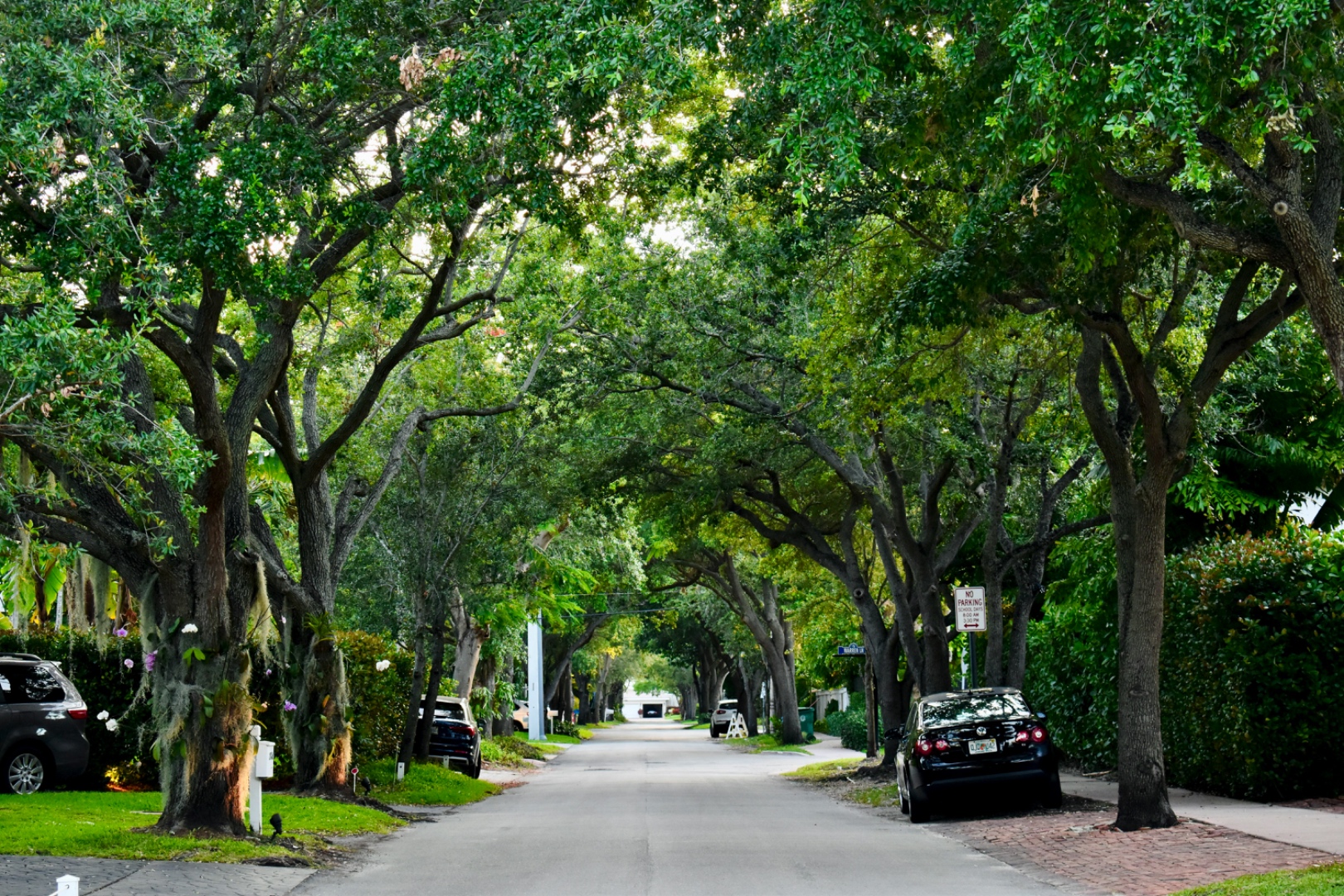
South Miami runs on Sunset Drive. The commercial spine gives the city a walkable core that most of Southwest Miami-Dade cannot match, and it is the reason a single-family home here lives more like an urban village than a suburb.
Dining and the Sunset Drive corridor. The everyday food scene skews toward cafes, bakeries, and casual international spots you can walk to rather than destination fine dining. Maman, the French bakery-cafe chain, holds a corner outpost on Sunset Drive. Cecile Bakery and Cafe sits near the Sunset Place site, and Shahs of Kabob brings Persian food to the corridor. The mix is neighborhood-serving, the kind of place you use on a weeknight and not only on a Saturday.
The Shops at Sunset Place, in transition. The open-air mall at the heart of downtown is slated for redevelopment. Midtown Development bought it for $65.5 million in a sale reported in January 2021, and the city commission unanimously approved the Heatherwick Studio-designed project in October 2024. The approved plan replaces the mall with seven towers between 12 and 33 stories: 1,513 residences, a 287-room hotel, a 1,300-seat movie theater, offices, restaurants and entertainment space. As of October 2026, demolition had not started and was targeted for early 2027, and the first phase, new streets plus the condo-hotel, carries a 2029 target. The 1,513 units are condos and rentals, so they will never appear in my single-family sale medians, but a rebuilt Sunset Place would change foot traffic, the restaurant mix, and the city's tax base. If you are buying nearby, check the current permit record and plan for years of construction on the site. A design approval is not a finished amenity, and redevelopment does not guarantee a gain in nearby home values.
Parks and green space. For a 2.3-square-mile city, South Miami keeps a real park system, more than a dozen parks and facilities. Dante Fascell Park, a 7.73-acre park at 8600 SW 57th Avenue (Red Road), carries six tennis courts, a jog-and-walk track, outdoor exercise equipment, and a sculpture garden. Fuchs Park, five acres at 6445 SW 81st Street, offers a pond with a fountain, a playground, a natural area, and a walking trail. Murray Park houses the Gibson-Bethel Community Center, with a gym, a fitness center and a multipurpose room. Between them, the city covers active recreation and quiet green space without a resident needing to leave the municipal boundary.
Civic and institutional anchors. South Miami Hospital, a major Baptist Health facility one block south of Sunset Drive, sits inside the city and is both a large employer and a convenience. The University of Miami campus sits just northeast of the city and shapes the rental market and the dining scene; UM enrolled 20,104 students in Fall 2025, and I break down what that means for home demand in The UM Effect. The Cambridge Lawns historic district adds a layer of architectural identity a newer suburb cannot manufacture.
The practical feel of the place is close-in and walkable, denser than the acreage neighborhoods to the south, quieter than Coconut Grove's nightlife, and organized along a single main street rather than sprawled across arterials.
Getting Around
Transportation & Access
South Miami holds one of the best access positions in Southwest Miami-Dade, and it is the rare local market where public transit is a real daily option rather than a technicality.
Metrorail. The South Miami station sits on the same track shared by Metrorail's Green and Orange lines. Each line runs on a ten-minute headway at weekday peak, so combined service through this corridor arrives every five minutes or so during rush hours. A one-way fare starts at $2.25. The ride north to Brickell, the core of the financial district, takes fifteen minutes. For anyone commuting into Brickell or downtown, that rail access can remove a car from the daily equation, which is something almost no other neighborhood in my service area can offer. It is a real structural advantage and a meaningful reason to weigh South Miami against a farther-out house with more square footage.
The Underline. A 10-mile linear park beneath the Metrorail guideway is stacking a second asset on the same corridor, from Brickell to Dadeland South. Its third and final phase, a 7.36-mile segment through the City of Miami, Coral Gables, South Miami and unincorporated Miami-Dade, is under construction. The first two phases opened in 2021 and 2024. The county's project page still lists 2026 for completion, so treat that as a target and check the page for current milestones. Once finished, the segment will give downtown South Miami a protected walking and cycling route toward Brickell in one direction and Dadeland in the other.
By car. US-1 (South Dixie Highway) runs straight through the city and feeds downtown and Brickell to the northeast; non-rush-hour drive time to Brickell or downtown runs 15 to 25 minutes depending on the hour. Coral Gables and Miracle Mile are five to ten minutes north. Miami International Airport is 27 to 28 minutes via the Palmetto Expressway (SR 826) to the Dolphin Expressway (SR 836), which is the standard routing north and then east to the terminals. Red Road (SW 57th Avenue) and SW 62nd Avenue handle north-south local movement, and the Palmetto is the closest limited-access highway, running north-south along the west side.
Between US-1, the Palmetto a few minutes west, and the Metrorail station downtown, South Miami gives more than one realistic way to reach the major job centers. In a region where most single-family neighborhoods leave you fully car-dependent, that optionality is a core piece of the value case for the city and a large part of why the per-foot rate holds where it does.
Roots
History & Character
The settlement began as Larkins, named for pioneer merchant W.A. Larkins, and the Florida Legislature converted the Town of South Miami into a city on June 24, 1927, according to the City of South Miami's published history. Boundary reductions in 1933 and 1937 cut the original six square miles down to today's irregular 2.3-square-mile footprint. Glenvar Heights left in that 1937 reduction, as its guide explains.
Sunset Drive has been the commercial spine since before incorporation. The city's own history places the 1920s land-boom epicenter near the original Riviera Theater, the same ground where the Shops at Sunset Place stands today, so the corner has anchored commerce here for a century.
Incorporation gives residents a city commission and manager, a municipal police department, a parks department, and local planning and code staff, all funded through the city's own millage. The city counted 12,026 residents at the 2020 Census, and its motto is "The City of Pleasant Living."
Client Experience
What Buyers & Sellers Say
Over 100 five-star reviews across Google, Zillow, and more
Jorge provided knowledgeable, courteous and timely support for us on our recent home purchase. He's very accessible and provided expert advice on the type of property we were looking for. He was also patient and not 'pushy' at all. Jorge went the extra mile, coordinating documents and performing a final walkthrough for us as we were not physically present at closing. Highly recommend.
Common Questions
Frequently Asked Questions
South Miami single-family homes closed at a $1,391,500 median in Q3 2026 across 22 sales, up 10.9% from Q3 2025. Median price per square foot was $738, and the median time to contract was 43 days. Over the past twelve months the median was $1,185,000 on 105 sales, a larger base for a city this small. Source: the site's polygon-classified MLS analysis. These describe the homes that sold; differences in location, condition, size, land and construction mix can affect the figures. They are not an appraisal of a particular home.
Source: Market methodology
South Miami is a 2.3-square-mile incorporated city along US-1, bordered by Coral Gables, Glenvar Heights and the University of Miami. Its limits run from Red Road on the east to SW 67th to 69th Avenue on the west, and from an irregular northern edge down to between SW 80th and SW 88th Street. A South Miami mailing address does not mean a house is inside the city, so check the municipal boundary.
Source: Metrorail, South Miami Hometown District, County property services
Sunset Elementary (10/10), the International Studies magnet, and South Miami K-8 Center (7/10), an arts magnet, are the best-known public options, with Ludlam Elementary (8/10) and David Fairchild Elementary (9/10) serving other parts of the area. The zoned high school is South Miami Senior High, graded B by the state for 2025-26. Assignment varies by address and the magnets admit by application, so confirm both with M-DCPS.
Source: Find Your Neighborhood School, M-DCPS parents, Sunset programs, South Miami K-8 programs, M-DCPS school grades, GreatSchools: David Fairchild Elementary, GreatSchools: Ludlam Elementary, GreatSchools: South Miami K-8 Center
Yes, if you want a walkable downtown and rail access for less than Coral Gables costs. Sunset Drive is the commercial spine, Metrorail reaches Brickell in about 15 minutes from South Miami station, and the median lot is 10,080 square feet. The tradeoffs are smaller lots than Glenvar Heights, a zoned high school the state graded B for 2025-26, below the A-graded elementary schools, and years of construction ahead at the Shops at Sunset Place site.
Source: Find Your Neighborhood School, M-DCPS parents, Metrorail, South Miami Hometown District, Market methodology
Work with someone who is there every day. Jorge's office is on Sunset Drive, and he prices South Miami block by block: the walk to Sunset Drive, the distance to the Metrorail station and whether the house is inside city limits at all. Jorge Guanche is a Compass agent ranked in the Top 1.5% nationwide by RealTrends, with 20+ years of experience in the immediate area and over 100 five-star reviews.
About 15 minutes to Brickell on Metrorail from South Miami station, with Green and Orange Line trains arriving every five minutes or so at weekday peak. By car it runs 15 to 25 minutes outside rush hour. Add the trip from the house to the station, and check Miami-Dade Transit for the current schedule.
Source: Metrorail
Listing sites use "South Miami" for a much wider area than the 2.3-square-mile city. Third-party sites lump in places that sit in Coral Gables, Kendall or unincorporated county, such as Cocoplum, Gables Estates and Olympia Heights, while this guide's market figures count only sales inside the city limits. Confirm a property's jurisdiction in the county's property records before relying on the label.
Source: Find Your Neighborhood School, M-DCPS parents, County property services
It can be either, decided property by property. For an owner-occupant, the case is the walkable core, Metrorail and the elementary schools at a lower entry than Coral Gables; for a rental, verify permitted use, realistic rent, operating expenses, vacancy and any association rules. Being near the University of Miami or the Sunset Place project does not guarantee rental demand or appreciation.
Source: Find Your Neighborhood School, M-DCPS parents, South Miami Planning & Zoning, County zoning, County flood property checks
Expect several years of construction on the site before any new amenity opens. The city commission unanimously approved the redevelopment in October 2024, and as of October 2026 demolition had not started and was targeted for early 2027. If you are considering a nearby house, check the current permit record, walk the surrounding streets and weigh the disruption; redevelopment does not guarantee a gain in the home's value.
Source: South Miami Hometown District, Sunset Place architect, Miami Today, October 7, 2026
About 25% of South Miami's single-family homes are in a FEMA high-risk zone today, almost all shallow AH zones, and the typical high-risk policy costs about $1,080 a year. That rises to 43% on FEMA's new maps, effective Feb 19, 2027, with those homes in Zone AE. If a home is moving into a high-risk zone, buying a flood policy within 12 months of the change can qualify it for FEMA's newly mapped pricing, which starts lower. The city's flood history is light, 163 claims since 1978, mostly from Hurricane Irene in 1999, Hurricane Andrew and the October 2000 storm.
How I source and verify the data behind this analysis → Data & Methodology
Direct Line
Ask About South Miami
Walkable blocks, school boundaries, condo trade-offs. Send what you're weighing and I'll reply personally.