Miami-Dade Property Tax Rates by Neighborhood: 2026-27 Combined Millage Guide
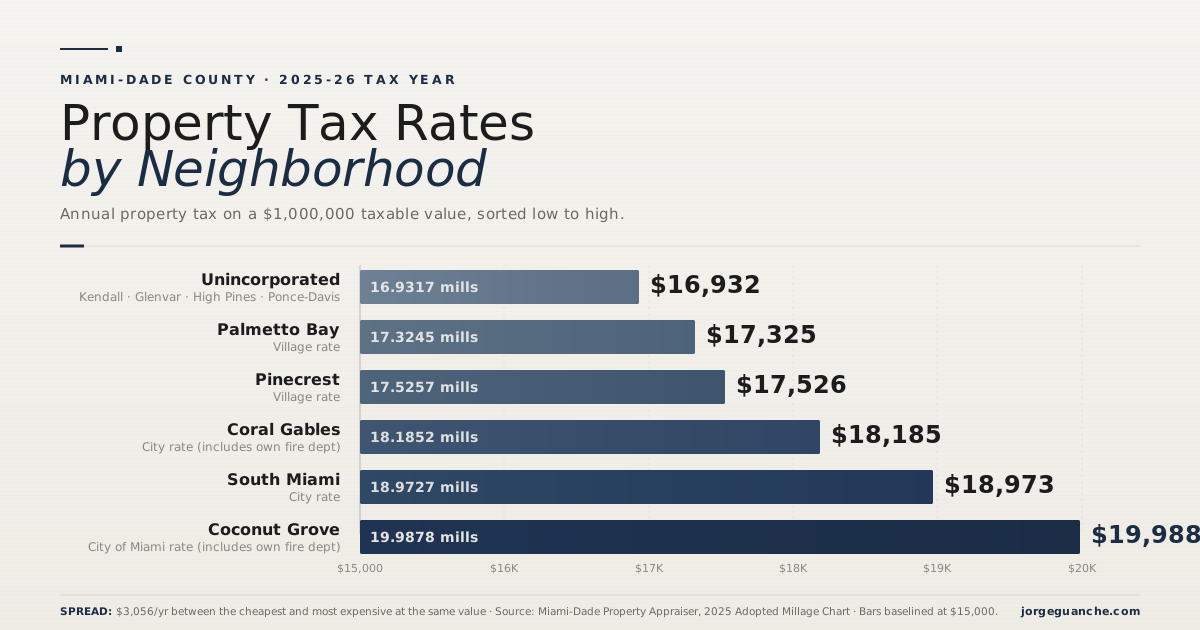
The 8 neighborhoods I cover in southwest Miami-Dade run from a combined 16.8983 mills (unincorporated areas including Kendall, Glenvar Heights, High Pines, and Ponce-Davis) up to 19.9544 mills (Coconut Grove, which pays the City of Miami rate). The spread is 3.0561 mills, or $3,056 a year on a $1,000,000 taxable value. Over a 10-year hold, that is $30,560 on the identical house. Millage is the single biggest swing variable in a cost-of-ownership comparison across these neighborhoods. Most buyers fixate on price per square foot. The tax bill is where the long-term math compounds.
About 12.59 of those mills are identical no matter which of the eight areas you buy in. County, school district and regional levies apply to everyone in Miami-Dade at the same rate. The only piece that actually moves is the municipal levy, and the whole 3-mill spread lives there, along with trade-offs that never appear on a tax bill. That is what the rest of this guide works through, area by area. It is the follow-up to the pillar piece on homestead, Save Our Homes and portability, which covers how your taxable value gets set in the first place.
Those are round numbers on a round example. For a specific address, send it to me and I will pull the folio, the current assessed value and whatever exemptions are already on it, so you are looking at the actual first-year bill instead of an illustration. Call or text me at 786-223-1117.
This calculator also lives at a standalone page you can bookmark or share.
What Is a Millage Rate?
A mill is one dollar of tax for every $1,000 of taxable value. A 17.34 mill rate equals $17.34 per $1,000, or 1.73%. The formula is the same one the pillar piece used:
Annual Tax = Taxable Value × Millage Rate ÷ 1,000
Take an example. A Palmetto Bay home with $750,000 in taxable value generates $750,000 × 17.3393 ÷ 1,000 = $13,004 in annual property tax. Move that same home to Coconut Grove and the math becomes $750,000 × 19.9544 ÷ 1,000 = $14,966. The home is identical. The bill differs by $1,962 per year because of jurisdiction.
What Goes Into a Combined Millage Rate?
The single combined number on your TRIM notice is a stack of 13 or 14 separate taxing authority levies, depending on where you live. The stack matters because most of the variation between neighborhoods comes from just two of the lines.
Countywide levies (everyone in Miami-Dade pays these regardless of city).
- Miami-Dade County operating: 4.5740 mills
- County debt service: 0.3937 mills
- Library District: 0.2812 mills
- Children's Trust: 0.4638 mills
Total countywide: 5.7127 mills. Same for everyone in all 8 areas here. (A handful of Miami-Dade municipalities have opted out of the Library District; none of the 8 areas in this article are among them.)
School District levies (everyone in Miami-Dade pays these).
- School operating (includes capital outlay): 5.4990 mills
- School voted operating: 1.0000 mills
- School debt service: 0.1240 mills
Total school: 6.6230 mills on every Miami-Dade property tax bill. The Property Appraiser reports the district's required local effort, discretionary operating, and capital outlay levies as a single 5.4990 operating line, which is why the operating number looks larger than the state-required minimum.
Regional levies (everyone pays).
- South Florida Water Management District: 0.0948 mills
- Everglades restoration: 0.0327 mills
- Florida Inland Navigation District: 0.0270 mills
- Okeechobee Basin: 0.1026 mills
Total regional: 0.2571 mills. Same across the county.
If you are moving from another Florida homestead, I use my homestead portability calculator to estimate how a transferred Save Our Homes benefit changes the taxable value before I apply these rates.
County Fire & Rescue: 2.3965 mills. Paid by Palmetto Bay, Pinecrest, South Miami, and all unincorporated areas. NOT paid by Coral Gables or City of Miami, which fund fire through their city budgets. This is one of the two biggest reasons combined rates vary.
City or UMSA municipal levy. The other big swing variable. Ranges from 1.9090 mills (unincorporated UMSA) up to 7.1080 mills (City of Miami operating) plus 0.2536 mills City of Miami debt. In Coral Gables and City of Miami the city portion includes fire; everywhere else it does not. Apples-to-apples comparison requires subtracting fire from those two before comparing.
Run the math. Everyone in these 8 areas pays 12.59 mills baseline (countywide + school + regional). The remaining 4.31 to 7.36 mills of variation comes from two lines: whether the area pays county fire, and what the city or UMSA charges.
What Are the Property Tax Rates in Each Southwest Miami-Dade Neighborhood?
Four of the eight areas I cover (Kendall, Glenvar Heights, High Pines, and Ponce-Davis) all sit inside Miami-Dade's unincorporated municipal services area and share a single combined rate. Coconut Grove sits inside the City of Miami boundary and pays the full City of Miami rate. That collapses the 8 geographies into 6 distinct rate buckets, sorted low to high below.
Unincorporated Miami-Dade: 16.8983 Mills
UMSA portion: 1.9090. Applies to 4 of my 8 coverage areas: Kendall, Glenvar Heights, High Pines, and Ponce-Davis. Geographically distinct, jurisdictionally identical for tax purposes.
On an $800,000 taxable value, a home in any of these four generates $800,000 × 16.8983 ÷ 1,000 = $13,519 in annual tax.
The lower rate comes with trade-offs. No municipal building department, no village hall, no separate code enforcement. County services handle police (MDPD), fire (Miami-Dade Fire Rescue), parks, and code. For buyers who value lighter regulatory touch and a lower carrying cost, this is among the lowest combined rates in the county. Only Key Biscayne, Sunny Isles Beach, Aventura, and Bal Harbour come in lower.
Palmetto Bay: 17.3393 Mills
Village portion: 2.3500 (up from 2.3018), which the village adopted at its September 23, 2026 Second Budget Hearing (verified in the village's September 24, 2026 hearing recap).
Run the math on a $1,000,000 taxable value: $1,000,000 × 17.3393 ÷ 1,000 = $17,339 in annual tax.
Incorporated in 2002. Residents pay 0.44 mills more than unincorporated for municipal control over zoning, parks, and code. That works out to around $440 per year per $1M taxable. For most Palmetto Bay buyers, that is the cost of having a village commission accountable to them on land-use decisions, rather than dealing with the county directly.
Pinecrest: 17.4923 Mills
Village portion: 2.5030, unchanged from 2025 after the village cut its July 2026 proposed rate of 2.6041 back to 2.5030 in September.
On $1,500,000 in taxable value, a Pinecrest home generates $1,500,000 × 17.4923 ÷ 1,000 = $26,238 in annual tax.
Every Pinecrest-zoned public school carried an A grade from the state for 2025-26, and the village runs its own parks department on top of what the county provides. The 2.5 mill village portion is the price of that infrastructure.
Coral Gables: 18.1518 Mills
City portion: 5.5590. The Coral Gables City Commission held the city's millage rate flat for the 13th consecutive year in September 2026 (Ordinance No. 2026-41, adopted at the September 29, 2026 Second Budget Hearing).
Take a Coral Gables home with $1,400,000 in taxable value: $1,400,000 × 18.1518 ÷ 1,000 = $25,413 in annual tax.
Important caveat on the city portion. Coral Gables runs its own fire and EMS department, so the 5.559 city millage funds fire service inside the city. Everywhere else in this list (except Coconut Grove) pays a separate 2.3965 county fire millage on top of the city or UMSA rate. Apples-to-apples, Coral Gables city services net of fire run 3.16 mills, which is in the same range as Pinecrest and Palmetto Bay. The headline city number looks high because it absorbs a line item other cities itemize separately.
South Miami: 18.9393 Mills
City portion: 3.9500, confirmed in the city's Adopted Budget FY 2026-2027.
A South Miami home with $750,000 in taxable value generates $750,000 × 18.9393 ÷ 1,000 = $14,204 in annual tax.
South Miami covers a small footprint with dense services and a walkable downtown corridor along Sunset Drive. The 3.95 mill city portion funds the most service-per-square-mile of any city in this list. Residents trade 2.04 mills above the unincorporated rate (about $2,041 per year on $1M taxable) for that density of city presence.
Coconut Grove (City of Miami Rate): 19.9544 Mills
City portion: 7.1080 operating + 0.2536 debt = 7.3616 city total. Confirmed in City of Miami Ordinance 14491, adopted September 24, 2026.
On a $1,200,000 taxable value, a Coconut Grove home generates $1,200,000 × 19.9544 ÷ 1,000 = $23,945 in annual tax.
Same fire caveat as Coral Gables. City of Miami runs its own fire and EMS, so the 7.11 mill city operating millage funds fire service inside the city. Net of the 2.3965 county fire millage other areas pay separately, city operating runs about 4.71 mills, still the highest city operating portion in this list. The city funds a much larger urban service load than any of the southern municipalities, and the millage reflects that.
Three Patterns Most Buyers Miss
The headline combined rate hides three things worth knowing before you run a cost-of-ownership comparison across these neighborhoods.
Pattern 1: The city portions are closer than they look once you net out fire. Coral Gables city millage looks like 5.56 mills against Palmetto Bay's 2.35 mills, more than double. But Coral Gables includes its own fire service in that 5.56. Subtract the 2.3965 county fire millage other areas pay separately and Coral Gables city services run 3.16 mills. Same exercise on City of Miami operating: 7.11 minus 2.40 equals 4.71 mills (the separate 0.25 mill city debt service stays on top). The municipal-services gap across these six areas is narrower than the headline city numbers suggest.
Pattern 2: The county headline rate has been flat for years, but the dollar bill has not. The countywide operating millage of 4.5740 has not moved meaningfully in recent cycles. The county press release for the FY 2025-26 adoption frames this as "the lowest combined tax rate since 1982." That is technically accurate. But over the same span, taxable values have run up substantially, so the actual dollar bill has risen even with flat millage. The bill is millage times value. Both move, and value has been doing most of the moving.
Pattern 3: Palmetto Bay is the one area that went up. Every other rate above is down slightly year over year, by 0.0334 mills, because county and school debt service fell. Palmetto Bay's combined rate rose 0.0148 mills from 2025, or $15 per year more on $1M taxable, because the village raised its own rate from 2.3018 to 2.3500. The village proposed 2.6900 in July 2026 and brought it down to 2.3500 in September. The final number is the compromise. Worth knowing if you are pricing a Palmetto Bay purchase.
How This Should Factor Into a Purchase Decision
Three angles I work through with buyers when millage matters to the choice.
Side-by-side carrying cost across neighborhoods. When a buyer is choosing between two areas at similar price points, the millage delta translates directly into annual carrying cost. Pinecrest versus Palmetto Bay at $1,500,000 taxable is $26,238 versus $26,009, a $229 per year spread that probably will not change anyone's mind. Coconut Grove versus Glenvar Heights at the same taxable value is $29,932 versus $25,347, a $4,585 per year spread that does. It changes the affordability math for the same home.
Resale comp and rental math. Higher-millage areas have to deliver service value buyers and tenants will pay for, otherwise the carrying cost erodes the appeal. Coral Gables clears that bar easily on schools, code enforcement, and infrastructure. Coconut Grove pays the same City of Miami rate as the rest of the city, which is a flat rate by design; what each neighborhood gets back in services varies. For investment property analysis, the millage delta hits net operating income directly. Cap rate math on a Coconut Grove rental looks different from cap rate math on a Kendall rental at the same gross income, primarily because of this line item.
The combined picture (millage plus taxable value plus exemptions). Millage is one variable. The other two are taxable value (set by the Property Appraiser, with the Save Our Homes cap controlling year-over-year growth for homesteaded properties) and the homestead exemption itself, which knocks $51,411 off taxable value for any qualifying primary residence in 2026, though only the first $25,000 of that comes off the school district portion. For the full mechanics on how those three variables interact, the pillar piece is the reference. This article isolates the millage piece. All three matter.
The August TRIM notice is where these rates land on paper. The window to challenge the value they are applied to closed on September 18, 2026 for this tax year. My guide to reading your TRIM notice and deciding whether to appeal covers what each column means and when a petition is worth the $15.
What Changed in September 2026
Every Miami-Dade jurisdiction adopts its next year's millage rate in September, effective October 1 and reflected on the November tax bill. The FY 2026-27 rates in this guide were set on that timeline.
Any reform that affects school millage (the largest single bucket at 6.6230 mills) shows up here too. See the pillar piece for the current state of the 2026 Florida legislative reform push (HJR 211, HJR 203, and the special session activity). Amendment 3 on the November 3, 2026 ballot would take effect January 1, 2027 if approved, so it does not change the November 2026 bills.
The 3.0561 mill spread is the carrying cost line most buyers never run before they sign. If you are buying or selling in southwest Miami-Dade in the next 90 days and want the per-property millage math run cleanly before you commit, I do this for every client. Reach me at 786-223-1117 or jorge.guanche@compass.com.
Sources
Miami-Dade County, FY 2026-27 millage ordinances adopted at the September 17, 2026 final budget hearing
Miami-Dade County, 2026-27 Budget Adopted release
City of Miami, Ordinance 14491, Second Budget Hearing, September 24, 2026
City of Coral Gables, Ordinance No. 2026-41, Second Budget Hearing, September 29, 2026
City of South Miami, Adopted Budget FY 2026-2027
Village of Pinecrest, Summary of the September 22, 2026 Final Budget Hearing
Village of Palmetto Bay, recap of the September 23, 2026 Second Budget Hearing
Miami-Dade County Public Schools, Adoption of Millage Levy Resolution FY 2026-27, September 9, 2026
Companion article: Property Taxes, Homestead, and Portability in Miami-Dade