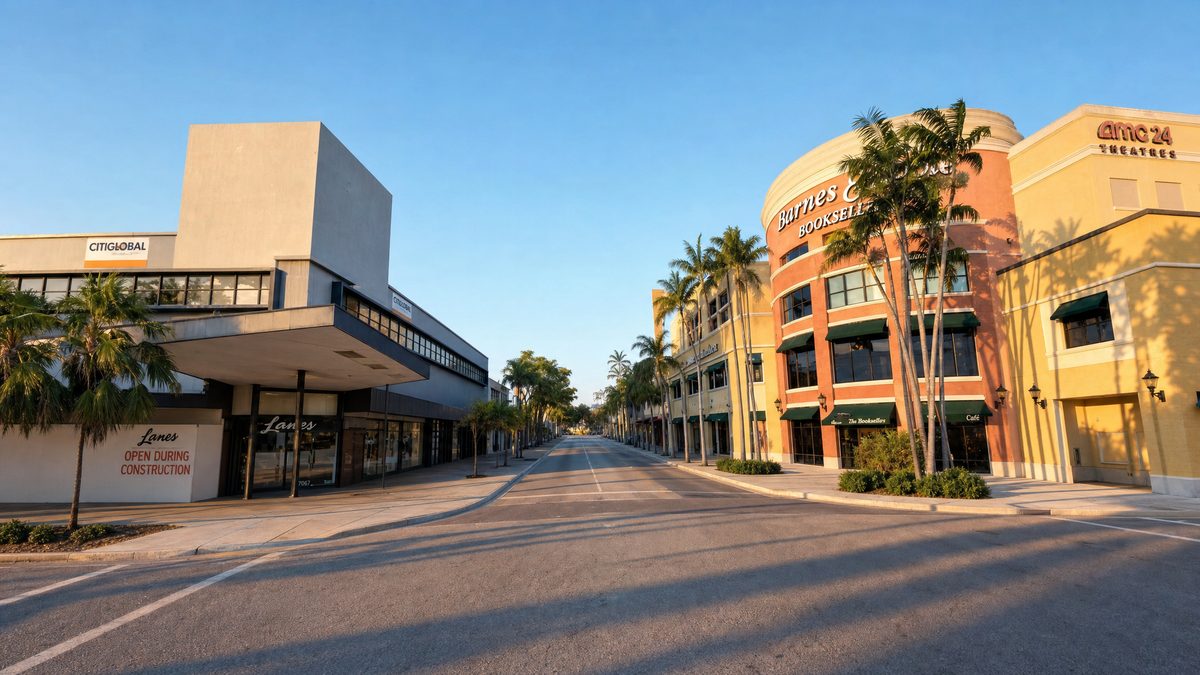
The Complete Guide to Living in South Miami
South Miami is an incorporated city, 2.3 square miles of it, with its own commission, police department, parks system, and tax rate. It is one of the two most accessible single-family markets among the eight areas I cover: the Q2 2026 median came in at $1,020,000, according to my polygon-verified MLS pull for Apr 2026 - Jun 2026. I work from 1515 Sunset Drive, in the middle of the city's downtown, so I watch this market from street level every working day. This guide covers what the city is, where the market stands, and what living here costs: housing stock, schools, taxes, transit, and the two institutions that keep demand steady.
Quick Reference: South Miami at a Glance
- Government: Incorporated city since June 24, 1927, commission-manager form, per the City of South Miami. The city's own motto is "The City of Pleasant Living."
- Population and size: 12,026 residents (2020 Census) across 2.3 square miles. Zip codes 33143 and 33155, both extending well past city limits.
- Median sold price: $1,020,000, down 7.3% year over year (polygon-verified MLS closed single-family sales, Apr 2026 - Jun 2026, 32 sales).
- Price per square foot: $655, up 0.8% year over year. Median days on market: 49.
- Inventory: 35 active single-family listings and 9 under contract as of 07/05/2026.
- Property tax: 18.9393 combined mills for 2026-27, second-highest of the eight areas I cover.
- Metrorail: South Miami station, on the Green and Orange lines. The Underline's final phase runs through the city and was still under construction as of September 2026.
- Schools: Sunset Elementary, Ludlam Elementary and South Miami K-8 Center. State grades A, A and B for 2025-26; GreatSchools 10/10, 8/10 and 7/10 as of September 19, 2026.
What Is South Miami? An Incorporated City of 2.3 Square Miles
Outside the county, people hear the name as a direction. Inside Miami-Dade, it is a specific municipality with a 1927 charter. The settlement began as Larkins, named for pioneer merchant W.A. Larkins, and the Florida Legislature converted the Town of South Miami into a city on June 24, 1927, according to the City of South Miami's published history. Boundary reductions in 1933 and 1937 cut the original six square miles down to today's irregular 2.3-square-mile footprint.
That confusion has a practical cost if you are shopping here. The 33143 zip code covers the city plus Glenvar Heights, High Pines, Ponce-Davis, and other unincorporated pockets at very different price points. A "South Miami" mailing address does not tell you if the home sits inside city limits, pays the city tax rate, or falls in the city's police service area. The city itself is bounded by Coral Gables, the University of Miami campus, Glenvar Heights, and unincorporated Miami-Dade, and it counted 12,026 residents at the 2020 Census.
Incorporation is a practical distinction. Residents get a city commission and manager, a municipal police department, a parks department, and local planning and code staff, all funded through the city's own millage. The trade side of that arrangement shows up in the tax section below.
Downtown Sunset Drive and the Sunset Place Redevelopment
Sunset Drive has been the commercial spine since before incorporation. The city's own history places the 1920s land-boom epicenter near the original Riviera Theater, the same ground where the Shops at Sunset Place stands today, so the corner has anchored commerce here for a century. The blocks around Sunset Drive and Red Road still hold the restaurants, offices, and storefronts that make this one of the few walkable downtowns in Southwest Miami-Dade, and City Hall sits on the same street.
The parks system covers the daily-life side. Dante Fascell Park runs 7.73 acres with six tennis courts on Red Road, Fuchs Park wraps a pond just off US-1, and Murray Park houses the Gibson-Bethel Community Center, a 22,000-square-foot recreation building, according to City of South Miami Parks & Recreation.
The biggest change coming to downtown is the Shops at Sunset Place redevelopment. Midtown Development bought the mall, which opened in 1999, for $65.5 million in 2021, and the City Commission approved a plan that would replace it with seven towers between 12 and 33 stories: 1,513 residences, a 287-room hotel, a 1,300-seat movie theater, offices, restaurants and entertainment space, according to The Real Deal. Those are the approved entitlements. Nothing described there has been built. The approval ties the developer to benchmarks for raising the property's taxable value.
As of July 2026, the actual status is slower than the headlines suggested. Demolition was scheduled to start in early 2026 and had not begun, with permits and condo presales still pending, per The Real Deal's July 1, 2026 update. The first phase, new streets plus the condo-hotel, carries a 2029 target, which is a developer target rather than a schedule. Check the city's current project and permit records before you weigh it. For homeowners, the realistic read is a multi-year construction period followed by a denser, retail-heavy core, and redevelopment does not guarantee a gain in nearby home values. The 1,513 units are condos and rentals rather than single-family stock, so they will never appear in my sale medians, but a rebuilt Sunset Place changes foot traffic, the restaurant mix, and the city's tax base.
The South Miami Real Estate Market in Q2 2026
Every figure in this section comes from my own pull of closed single-family sales, reassigned to the actual city polygon by latitude and longitude rather than the neighborhood label a listing agent typed into the MLS. Mislabeling is chronic in this corridor, and the zip-code overlap makes South Miami especially prone to it.
The Q2 2026 pull (Apr 2026 - Jun 2026) covers 32 closed single-family sales at a $1,020,000 median and $655 per square foot, up 0.8% year over year, with a median of 49 days on market. As of 07/05/2026, 35 single-family homes were active and 9 were under contract.
One caveat belongs next to the quarter-over-quarter comparison. Q1 2026 posted a $1.37M median, so the drop into Q2 looks dramatic. At 32 to 35 sales per quarter, a handful of closings at either end of the price range moves the median substantially, and a single quarter does not establish what changed. Price per square foot held at $655 against $657 in Q1 and days on market ticked from 46 to 49, which is worth knowing, though price per square foot carries the land and the mix too and does not isolate the size of what sold. Year over year is the honest read, and it shows the median down 7.3%. This market has cooled, and buyers have more room to negotiate than they had a year ago.
The context ladder puts the price level in perspective. Miami-Dade's countywide single-family median was $680,000 in May 2026 with 5.2 months of supply, according to MIAMI Realtors. Among the eight areas I cover, South Miami and Kendall are the two most accessible entry points, and Kendall's Q2 2026 median came in at $1,092,500. Above those two the ladder climbs fast: Coral Gables at $2,550,000, Coconut Grove at $2,750,000, Glenvar Heights at $2,394,990 (on 27 closings this quarter), and High Pines + Ponce-Davis at $7,250,000 across just 15 sales.
Supply is the other half of that picture. At 32 sales a quarter, or 10.7 a month, the 35 active listings work out to close to 3.3 months of inventory, tighter than the county's 5.2.
Carrying costs are moving in the buyer's favor on two fronts. The average 30-year fixed mortgage stood at 6.43% as of July 2, 2026, per Freddie Mac. And Citizens' approved 2026 rates cut Miami-Dade HO-3 homeowners premiums by an average of 14.0% across 42,386 policies, effective July 1, 2026 for new policies and at renewal for existing ones. HO-3 is the form that lands on the insurance line of a single-family buyer's monthly math; other policy types moved by different amounts. A published average is not a guaranteed reduction on any one house, so get a property-specific quote early.
Housing Stock: What You Are Buying in South Miami
The typical South Miami single-family home is a one-story postwar house on a modest lot; the median lot in my trailing-year data ran 10,080 sq ft / 0.23 acres (MLS, Apr 2025 - Mar 2026). The range spans original mid-century ranches, renovated and expanded versions of the same houses, and new-construction infill, with Cambridge Lawns, the city's designated historic district, preserving one of the older intact residential pockets. New construction is the fastest-moving end of the stock: my cost analysis found South Miami carries the largest new-construction premium of the neighborhoods analyzed, +66% per square foot over the blended single-family market, and the new construction vs. renovation breakdown runs that math in full.
Condos and townhomes cluster near the downtown core and the Metrorail station. The medians above exclude them; they are a different market with different math. If you are comparing a townhome near Sunset Drive against a single-family home five blocks out, price per square foot alone will mislead you, because land value and association fees pull in opposite directions.
Schools in South Miami
Sunset Elementary is the school that moves markets here. It graded A from the state for 2025-26 and shows 10/10 on GreatSchools as of September 19, 2026, runs an International Studies magnet, and had 1,192 students in the district's October 2024 count, on Sunset Drive at the city's eastern edge. Its attendance zone takes in a meaningful share of the city's residential streets along with parts of High Pines and Glenvar Heights. Ludlam Elementary serves the west side, also an A and 8/10. South Miami K-8 Center, a visual and performing arts magnet inside city limits with 505 students in October 2024, graded B and shows 7/10, and the adjacent South Miami Middle School graded A and shows 7/10.
The secondary picture is where families do their homework. South Miami Senior High is the zoned high school, graded B from the state for 2025-26 and 3/10 on GreatSchools, a gap worth understanding before it decides anything. In practice many households plan on magnet applications, which carry their own admission requirements, charter seats such as Somerset Academy's middle school campus in the city, an A from the state and 10/10, or private options for the upper grades.
One rule matters more than any of these numbers: assignment depends on the address, the grade level and the district's current attendance boundaries, and in this corridor those boundaries are irregular and do not follow city limits. Verify the zone for the specific address before you write an offer; I run this check for every buyer client.
Property Taxes: What 18.9393 Mills Means
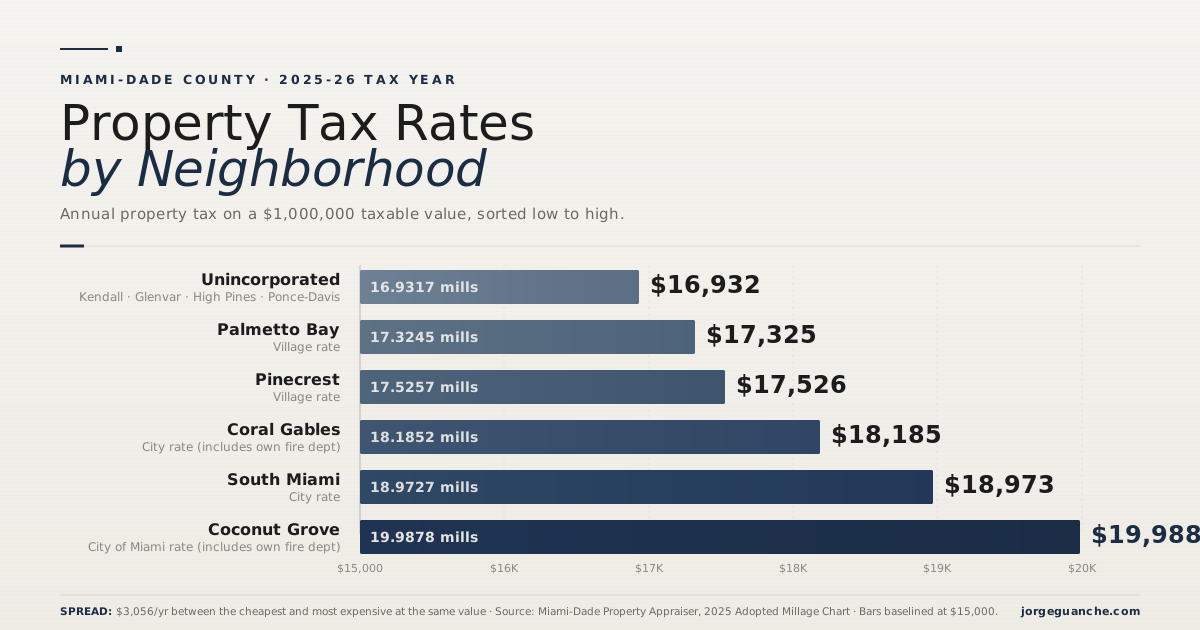
South Miami's combined 2026-27 millage is 18.9393 mills, the second-highest of the eight areas I cover, with the city's own portion at 3.9500 mills. On $1,000,000 of taxable value that is $18,939 a year. The full line-item breakdown, the homestead exemption math, and a calculator that runs your purchase price against all eight areas live in my property tax rates by neighborhood guide; every rate there is verified against the September 2026 final budget hearings of Miami-Dade County, the School Board and each city.
What the premium buys is service density: a municipal police department, the parks and facilities above, planning and code staff, and a government scaled to a 2.3-square-mile footprint. Two timing notes matter for anyone moving to South Miami from out of state. Rates re-adopt every September, so the FY 2026-27 numbers land in September 2026, and the homestead exemption requires a timely filing after you close on a primary residence. Run both before you commit to a monthly number.
Metrorail, The Underline, and Getting Around
The South Miami Metrorail station borders the downtown core, and it is the asset that separates this market from nearly everything else I cover. Green and Orange line trains share track through this corridor, so peak-hour service combines to a train every 5 minutes or so. Fares run $2.25 one way, and the ride to Brickell takes 15 minutes. Most of Southwest Miami-Dade is car-dependent; this is the rare pocket where a daily rail commute is realistic.
The Underline is stacking a second asset on the same corridor. The 10-mile linear park beneath the Metrorail guideway runs from Brickell to Dadeland South, and its third and final phase, a 7.36-mile segment passing through Coral Gables, South Miami and unincorporated Miami-Dade, is under construction. The first two phases opened in 2021 and 2024. The county had pointed to 2026 for the final phase; segments of it were still listed as under construction when I checked in September 2026, so treat any completion date as a target and check the project page for current milestones. The finished segment gives downtown South Miami a protected walking and cycling route toward Brickell in one direction and Dadeland in the other.
By car, US-1 crosses the city and delivers Brickell or downtown in 15 to 25 minutes depending on the hour. US-1 congestion is real, and it is exactly why the rail option carries weight here. Red Road and SW 62nd Avenue handle most of the local north-south traffic.
Two Demand Anchors: The University of Miami and Baptist Health
South Miami sits directly against the University of Miami's Coral Gables campus, and the effect on housing demand is measurable enough that I wrote a separate analysis of it: The UM Effect. The short version is that UM enrolled 20,104 students in Fall 2025, employs more than 10,000 faculty and staff together with its UHealth system, and is in an active construction phase on campus. Faculty and staff shopping this corridor consistently shortlist South Miami for the walk-to-work and rail options. That is a steady source of buyers and tenants, not a guarantee against a downturn in prices.
Baptist Health South Miami Hospital is the other anchor: a 452-bed hospital, per Baptist Health, one block south of Sunset Drive, with a campus that effectively fuses to the west end of downtown. Staff form a steady share of the buyer and tenant pool here alongside UM employees and commuting professionals. Two institutions of that size within a mile of the same downtown is an unusual demand structure for a small city. It broadens the buyer pool; it does not put a floor under prices, and this quarter's median is down 7.3% year over year with both anchors in place.
Who South Miami Fits
The buyers who close here share a pattern. They want a single-family home, they put walkability and transit high on the list, and they accept a smaller lot and a higher tax rate to get both. Commuters working in Brickell, downtown, or the Health District get the rail option. UM and hospital employees are a short walk or ride from work. For anyone cross-shopping Coral Gables, the draw is a downtown of its own, the rail station, and a median $1,530,000 lower this quarter.
At the entry end of my coverage area, South Miami is one of the two most reachable markets, and my first-time buyer's guide to Southwest Miami-Dade maps out how to compete at this price point. The fit weakens if land is the priority: lots here are modest by design, and buyers whose first requirement is acreage usually end up west of the city, where parcels run larger.
The Next Step
If South Miami made your shortlist, send me your budget and the streets you are weighing. I will run the polygon-verified comps, the tax math at the address level, and the school-zone check, and tell you plainly what your number buys inside city limits versus just outside them. Call 786-223-1117 or email jorge.guanche@compass.com. My South Miami neighborhood page keeps the at-a-glance data and active inventory current between guides like this one.
Sources
City of South Miami, History of South Miami (southmiamifl.gov), incorporation date, Larkins origin, Riviera Theater site, and "The City of Pleasant Living" motto
City of South Miami Parks & Recreation (southmiamifl.gov), Dante Fascell Park, Fuchs Park, Murray Park, and Gibson-Bethel Community Center facility details
U.S. Census Bureau, 2020 Census, City of South Miami population (12,026)
GreatSchools.org, school profiles checked September 19, 2026: Sunset Elementary (10/10), Ludlam Elementary (8/10), South Miami K-8 Center (7/10), South Miami Middle School (7/10), South Miami Senior High (3/10), Somerset Academy Charter Middle School South Miami Campus (10/10)
Miami-Dade County Public Schools, History of School Grades 1999 to 2026, as of September 1, 2026, and the 2024-25 school dashboards for October 2024 enrollment
The Real Deal, "Mixed-use mania: Mapping mall redevelopments planned in South Florida," July 1, 2026, Shops at Sunset Place acquisition price, approved program, demolition status, and phase-one timeline
Miami-Dade County, The Underline project pages, Phase 3 scope (7.36 miles, SW 19th Avenue to Dadeland South) and expected 2026 completion; phase opening dates 2021 and 2024
Baptist Health South Florida, South Miami Hospital facility profile, 452 beds
Miami-Dade County, School Board and City of South Miami final budget hearings, September 2026, verified October 2026, and City of South Miami Adopted Budget FY 2026-2027, combined 18.9393 mills and 3.9500 city portion (as published in my millage guide)
MIAMI Realtors, May 2026 single-family statistics, Miami-Dade median $680,000 and 5.2 months of supply
Freddie Mac Primary Mortgage Market Survey, average 30-year fixed rate 6.43% as of July 2, 2026
Citizens Property Insurance Corporation, Revised 2026 Rate Kit, Miami-Dade HO-3 average decrease 14.0% across 42,386 policies, approved rates effective July 1, 2026
University of Miami Office of Institutional Research and Strategic Analytics, Fall 2025 enrollment (20,104), as cited in my University of Miami real estate impact analysis
MLS, closed single-family sales polygon-reassigned to true city boundaries, Apr 2026 - Jun 2026 and Q1 2026; active inventory snapshot as of 07/05/2026