Amendment 3 Passed: What It Saves Miami-Dade Homeowners, Address by Address
Photo: NancyHeise, Wikimedia Commons, public domain, cropped
For anyone who owns and lives in a home in Miami-Dade, Amendment 3 is a tax cut written into the state constitution. The headline number is easy to repeat and easy to misread, because what a house saves depends on its assessed value, its city and when its owner became a Florida resident.
Start with the calculator: look up your address and it shows the 2026 bill next to the 2027 and 2028 estimates. The sections after it explain the math, the savings in each neighborhood, what could take some of it back, and the December 31 deadline for anyone moving here.
Amendment 3 Calculator: Look Up Your Address
What Amendment 3 Changes on a Miami-Dade Tax Bill
A Miami-Dade bill is taxed in two parts, each on its own taxable value. The school district levied 6.6230 mills in 2026. Everything else adds up to the rest of the combined rate: the county, your city or the unincorporated area, the water management district, the Children's Trust and, in some areas, the fire rescue and library districts. That comes to 10.2753 mills in unincorporated Miami-Dade and 11.5288 in Coral Gables.
Today the homestead exemption takes $25,000 off the value the school district taxes and $51,411 off the value everyone else taxes. Amendment 3 leaves the school side alone and replaces the non-school side. The first bill it changes is the one mailed in November 2027.
| Tax year | School levies | All other levies | Bill it shows on |
|---|---|---|---|
| 2026 (today) | $25,000 | $51,411 | November 2026 |
| 2027 | $25,000 | $150,000 | November 2027 |
| 2028 | $25,000 | $250,000 | November 2028 |
| 2029 on | $25,000 | $250,000, adjusted yearly for inflation | Each November |
The arithmetic is the same for each side: Annual Tax = Taxable Value × Millage Rate ÷ 1,000. Take a homesteaded house in unincorporated Miami-Dade, the area that covers Glenvar Heights, Kendall, High Pines and Ponce-Davis, assessed at $700,000:
- School tax: ($700,000 − $25,000) × 6.6230 ÷ 1,000 = $4,471, the same in all three years
- Everything else in 2026: ($700,000 − $51,411) × 10.2753 ÷ 1,000 = $6,664
- Everything else in 2028: ($700,000 − $250,000) × 10.2753 ÷ 1,000 = $4,624
- Total bill: $11,135 in 2026, $10,122 in 2027 and $9,094 in 2028
That is a $2,041 cut, about 18% of the bill, with the assessed value held where it is.
The exemption is a flat dollar amount, so once a home is assessed above $250,000 the saving stops growing. A $700,000 assessment and a $3,000,000 assessment in the same city save the same dollars.
Assessed value is the capped figure on your TRIM notice. On a homestead owned for decades it sits far below market value, and many of those owners will owe only the school portion from 2028.
If you already have a homestead exemption, Hillsborough County's tax collector advises that you will not need to file anything new for the larger one. Property appraisers note the Legislature may still add procedures, so watch for notice from the Miami-Dade Property Appraiser before the 2027 roll.
Amendment 3 does not eliminate property taxes. The Legislature's original ballot summary described a schedule for full elimination, and that language was dropped from the rewritten summary on the November ballot. The text instead tells the Legislature to write a procedure that lets counties and cities raise the exemption on their own taxes, up to the full assessed value. Using it is each local government's choice, and the amendment sets no date for it.
The text also lists what county and city property taxes may pay for: public safety, schools, roads and other infrastructure, flood control, debt, pensions, and general operations, which include other spending a local board approves unless state law bars it.
Amendment 3 Savings by Neighborhood
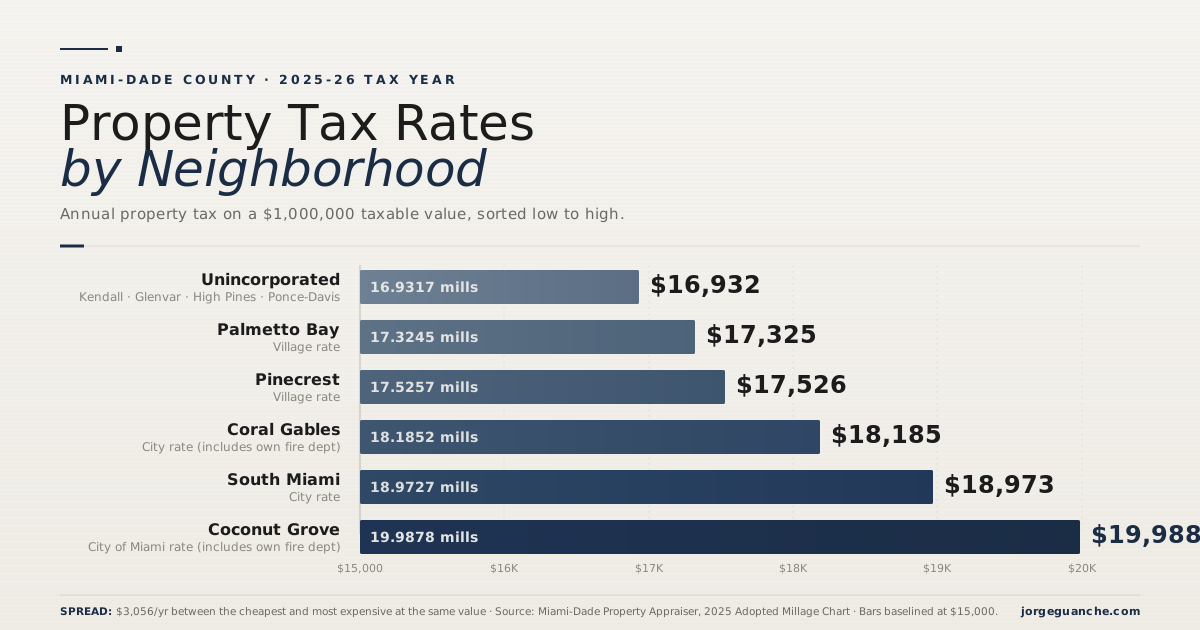
For any homestead assessed at $250,000 or more, the saving depends only on where the house sits, because the non-school rate is the only variable. These are the 2026 adopted rates from the Miami-Dade Property Appraiser's millage chart.
| Area | Combined millage | Non-school millage | 2027 saving | Saving from 2028 |
|---|---|---|---|---|
| Unincorporated (Glenvar Heights, Kendall, High Pines, Ponce-Davis) | 16.8983 | 10.2753 | $1,013 | $2,041 |
| Palmetto Bay | 17.3393 | 10.7163 | $1,057 | $2,128 |
| Pinecrest | 17.4923 | 10.8693 | $1,072 | $2,159 |
| Coral Gables | 18.1518 | 11.5288 | $1,137 | $2,289 |
| South Miami | 18.9393 | 12.3163 | $1,214 | $2,446 |
| City of Miami (Coconut Grove) | 19.9544 | 13.3314 | $1,314 | $2,647 |
Saving against the 2026 bill, with rates and assessed value held at 2026 levels. 2027 saving = ($150,000 − $51,411) × non-school millage ÷ 1,000. Saving from 2028 = ($250,000 − $51,411) × non-school millage ÷ 1,000. Source: Miami-Dade Property Appraiser, 2026 Adopted Millage Rates.
Florida TaxWatch ran the same arithmetic statewide at an average of 10.5 non-school mills and got $1,035 for 2027 and $2,085 for 2028. Unincorporated Miami-Dade, at 10.2753 mills, lands a little under that.
Because the saving is a fixed dollar figure, it is a larger share of a smaller bill. A Coral Gables homestead assessed at $500,000 pays $8,318 today and $6,028 from 2028, 28% less. One assessed at $1,500,000 drops from $26,469 to $24,180, 9% less.
What Could Shrink the Savings
The amendment fixes the exemption in the constitution. It does not fix the rates, and that is where most of the risk sits.
Local Rates Can Rise
Miami-Dade County puts its loss at about $385.8 million in the budget year that starts in October 2027 and $696.7 million a year once the $250,000 exemption is in place. Mayor Daniella Levine Cava warned before the vote that it could force cuts to bus routes and service hours, according to CBS Miami.
Cities face the same math, and their main tool is the "rolled-back rate," the rate that raises the same dollars as last year on the current roll. When exemptions shrink the roll, that rate rises, and Florida TaxWatch points out a government can adopt it with a simple majority vote.
Going past it is harder under CS/SB 4-F, a law the Legislature passed alongside the amendment and in effect since June 2026. Up to 110% of the rolled-back rate takes a two-thirds vote. Anything above that takes a unanimous vote, a three-fourths vote on a board of nine or more, or a referendum.
Those vote rules are the working limit. The constitution caps county and city operating rates at 10 mills each, and every city here sits well under it: Coral Gables levies 5.5590 mills for its own operations, Pinecrest 2.5030, Palmetto Bay 2.3500, South Miami 3.9500 and the City of Miami 7.1080.
On a single bill, the break-even sits a long way up. In unincorporated Miami-Dade, combined non-school rates would have to climb 4.53 mills, or 44%, before the 2028 saving on a $700,000 assessed homestead disappeared. The calculator shows that break-even for any address and lets you test a 0.5, 1 or 2 mill increase as an illustration. The rates local governments propose for 2027 show up first on the August 2027 TRIM notice, which lists each one's proposed rate next to its rolled-back rate.
Fees Can Rise Instead
Charges levied per property, like garbage, stormwater and special assessments, sit outside the exemption. Miami-Dade has used fees to fill a budget hole before. To close a deficit of more than $400 million, the county raised water and sewer fees and eliminated some positions, Axios Miami reported.
School Taxes Do Not Change
The school district keeps its $25,000 exemption and its rate. On a $700,000 assessed homestead in unincorporated Miami-Dade, the school portion is $4,471, which is 40% of the 2026 bill and nearly half of the 2028 bill.
A Purchase Resets the Assessment
A buyer's bill starts from the Property Appraiser's market value as of the January 1 after closing, so the seller's capped bill never transfers. Portability still lets you carry up to $500,000 of Save Our Homes benefit from one Florida homestead to the next, and the amendment leaves that cap alone.
Second Homes and Rentals Get a Different Benefit
Property that is not a homestead gets no part of the new exemption. What it gets is a lower cap on how fast its non-school assessed value can rise: 5% a year from 2027, down from 10%.
Amendment 3 for New Residents: The December 31, 2026 Deadline
This is the part of the amendment with a date on it. Its text gives the new $150,000 and $250,000 exemptions to every homestead owner except one group: a person who "had not maintained a permanent residence in this state as of December 31, 2026." Someone in that group gets $50,000 off non-school taxes, slightly less than today's $51,411, for the first four years of the exemption, and the full amount from the fifth. That $50,000 adjusts for inflation from 2028.
On a house in the eight neighborhoods, the gap between the two groups is $2,055 to $2,666 a year at today's rates, or $8,220 to $10,665 over the four years. On a $1,200,000 purchase in Coral Gables, assuming the Property Appraiser assesses it at 85% of the price, or $1,020,000, the buyer who was already a Florida resident pays roughly $15,467 a year once the full exemption applies. The buyer who arrived in 2027 pays $17,773.
The line turns on residency, and owning a home here by December 31 is not required. Someone who has moved here and rents while they shop is in the larger group, provided Florida is their permanent home. The Pinellas County Property Appraiser's guide to the amendment reads it the same way.
The Legislature still has to set the procedures for proving residency, and as of November 4 it has not passed them. Until it does, the best guide is the list Florida law already gives property appraisers for judging permanent residency:
- A declaration of domicile recorded with the Clerk of the Court in your county, a sworn statement under Florida Statutes section 222.17 that puts a date on the record
- A Florida driver license, with your out-of-state license surrendered
- Florida voter registration at your Florida address
- A Florida tag on your car
- Your Florida address on your federal tax return, bank accounts and utility bills
- Proof of when your residency in another state ended
- Where you work and where your children are registered for school
Buying and moving in before January 1 is worth a year on its own, because homestead status is set on January 1. Close, move in and make the house your permanent residence before January 1, 2027, file by March 1, 2027, and your first bill on the house carries the $150,000 exemption. Close on January 5 and that house carries no homestead exemption until 2028.
From 2030, a county or city may shorten the five-year wait by a two-thirds vote of its governing body, for what the amendment calls a critical local need.
One caution on the rule itself. In 1982, in Osterndorf v. Turner, the Florida Supreme Court struck down a five-year residency requirement the Legislature had placed on the homestead exemption, finding no rational basis for treating newer residents differently. This rule is written into the constitution, so a challenge would have to rest on the U.S. Constitution, and the rewritten ballot summary says the rule applies to the extent the U.S. Constitution allows. No ruling exists yet, so the safe plan is to be on the right side of December 31.
If you are relocating, make the move real before December 31, document it, and file for homestead as soon as you own the home you live in. I expect the deadline to pull some out-of-state purchases forward into December, because the four-year difference runs $8,220 to $10,665 on a house in these neighborhoods.
What It Means If You Are Buying or Selling
For a buyer who will live in the house and was a Florida resident by December 31, 2026, the carrying cost of a home in these neighborhoods falls by $2,000 to $2,650 a year from 2028. In buying power, that is about the yearly principal and interest on $25,000 to $32,000 of mortgage at the 7.24% average 30-year rate Freddie Mac reported on October 29.
A buyer arriving from out of state in 2027 pays slightly more than today's bill for four years, since $50,000 is $1,411 less than the current exemption, and gets the full saving from the fifth.
For sellers, the bill a buyer will pay is now a stronger selling point, and it is worth showing. A listing that prices the buyer's first-year tax under the new exemption, at the buyer's assessed value instead of the seller's, answers a question relocating buyers ask early.
If you are moving within Florida, both benefits apply. Portability carries up to $500,000 of Save Our Homes benefit to the new house and lowers its assessed value, and the new exemption then comes off that lower figure. My property tax and portability guide walks through the first part, and the millage guide has the rate behind every number here. The same calculator has its own page, the property tax and Amendment 3 calculator, and the rest of my calculators and the quarterly market report cover the price side.
If you want the bill on a specific house run before you buy, sell or move, send me the address. I will pull its assessment and exemptions and run 2027 and 2028 the same way. Call or text me at 786-223-1117.
Sources
Florida Legislature, CS/HJR 1-F (2026 Special Session F), enrolled text of the amendment
Florida Legislature, CS/SB 4-F (Chapter 2026-240), Property Tax Administration, enrolled text
Florida Statutes 196.015, permanent residency factors, and 222.17, declaration of domicile
Miami-Dade Property Appraiser, 2026 Adopted Millage Rates
Hillsborough County Tax Collector, Property Tax Reform
Pinellas County Property Appraiser, Amendment 3 FAQ
WLRN / News Service of Florida, Florida approves Amendment 3 tax cut, Nov 3, 2026
Miami-Dade County, Amendment 3 revenue estimates
Florida TaxWatch, The Florida Taxpayers' Guide for the 2026 Constitutional Amendments
Florida Statutes 102.111, Elections Canvassing Commission
Osterndorf v. Turner, 426 So. 2d 539 (Fla. 1982)
WLRN / Florida Phoenix, Amendment 3 ballot title, summary language don't pass muster, judge rules, Aug 4, 2026
Jones Walker LLP, Florida's revised property tax amendment ballot language, Aug 2026
CBS12, rewritten Amendment 3 ballot language, Aug 2026
Axios Miami, Where Miami-Dade officials stand on Amendment 3, Oct 7, 2026
CBS Miami, Miami-Dade mayor warns Amendment 3 could cost transit more than $29 million, Oct 28, 2026
Freddie Mac, Primary Mortgage Market Survey, Oct 29, 2026
Miami-Dade County Open Data, Property Point View, and the Miami-Dade Property Appraiser property record (calculator lookups)